 vi
 en
 kr
 jp
 cn




The transportation industry requires materials that not only have high durability but also have optimal weight, are anti-corrosion, resistant to vibration and meet stable production requirements. At Oristar, we supply aluminum, copper, steel and technical alloy groups serving three main sectors: railway, marine and automobile - motorbike. Each material is selected based on the location of use, load, working environment and actual processing method.
What requirements do transportation industry materials need to meet?
There is no single material that can satisfy every position on trains, ships or cars. A structural detail that needs to bear a load will have completely different criteria than an electrical conductor, connector, battery case or part working in a seawater environment.
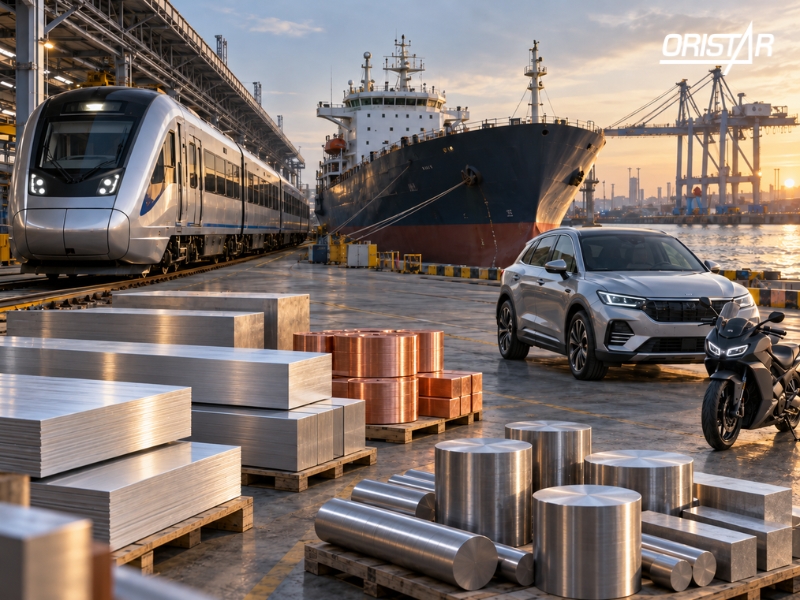
When consulting on materials for the transportation industry, we often focus on 5 main groups of requirements:
- reduce weight
- Ensures durability and load-bearing capacity
- anti-corrosion
- electrical and thermal conductivity
- Maintain stability during mass production.
Reduce weight but do not reduce safety
Reducing vehicle weight helps:
- reduce energy consumption;
- increased useful load;
- improve operational performance;
- increase the range for electric vehicles;
- Reduce load on related structural assemblies.
This is why aluminum plays an increasingly important role in transportation vehicles. However, it is not possible to replace steel with aluminum in every position. The selection must be based on the actual load, thickness, semi-finished product form and design of the part.
Resistance to load, vibration and fatigue
Transport vehicles are always subject to changing loads during operation.
For example:
- Cars are subject to vibration, acceleration, braking and road surface loading
- Trains are subjected to repeated loads over long distances
- Ships are subject to vibrations, impacts and loads due to waves.
Therefore, in addition to durability limits, materials also need to be evaluated for:
- toughness
- fatigue tolerance
- resistance to deformation
- long term stability.
Corrosion resistance
The transportation environment can be very harsh.
Parts that may come into contact with:
- water
- water
- salt
- humidity
- chemicals
- oil
- temperature changes.
Therefore, 5xxx aluminum alloys, stainless steel and materials with good corrosion resistance play a very important role in suitable applications.
The ability to conduct electricity and heat
With vehicle electrification, copper demand is increasing in:
- electrical system
- engine
- guide bar
- connector
- battery
- control device.
Therefore, current transportation industry materials cannot be viewed only from a mechanical perspective.
Which transportation sectors does Oristar provide materials for?
In the transport group, we focus on three sectors with very different material requirements: rail, marine and auto – motorbike. Each field will use different metal groups according to the function of each part.
Materials for the railway industry
The modern railway industry is developing in the direction of reducing rolling stock weight, increasing durability, optimizing energy consumption and reducing maintenance costs. In particular, aluminum is widely used for coach bodies, floor panels, roofs and shaped structures thanks to its low weight and ability to be produced into long profiles.
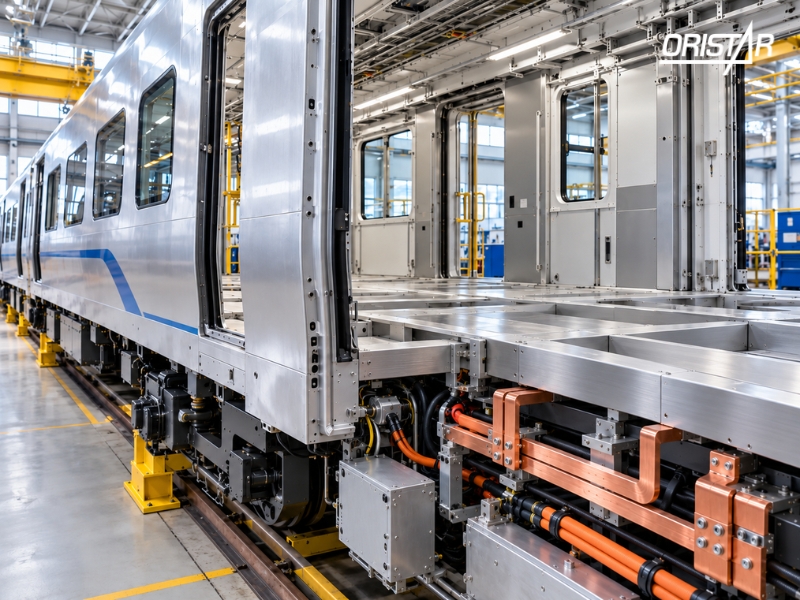
With the railway application group, we orient materials according to each function instead of just choosing by name.
Part/application | Suitable material group |
Car body and structure reduce weight | Aluminum |
Floor, roof, wall panels | Aluminum |
Long structural profile | Shaped aluminum |
Mechanical components | Aluminum/Stainless Steel |
Electrical system | Copper |
Conductor bar | C1100/C1020 |
Connectors, conductive parts | Copper alloy |
Anti-corrosion details | SUS304/SUS316 |
Aluminum in train car structure
Aluminum has a clear advantage with long structures and large areas.
In fact, aluminum is used for:
- side of the train car
- roof
- floor
- link bar
- shaped structure.
Extruded aluminum solutions help create long profiles, reduce the number of details and reduce the number of welds compared to structures assembled from many small parts.
For each project, specific marks need to be determined according to:
- blueprint
- required durability
- welding ability
- specifications
- length
- technical standards.
We do not recommend choosing a common aluminum grade for the entire train car.
Copper in railway electrical systems
Besides mechanical structures, electrical systems on ships are also an important group of applications. Materials such as C1100 and C1020 can be considered for:
- guide bar;
- power connection;
- conductive details;
- electrical equipment;
- parts requiring high conductivity.
For connectors that require a balance between conductivity and hardness, copper alloys are more suitable than pure copper.
Materials for the marine and shipbuilding industries
The marine environment places high demands on corrosion resistance, weldability and long-term stability. Therefore, when choosing materials for the marine industry, we give first priority to the ability to work in seawater environments and continuous outdoor conditions.
Currently, in the shipbuilding group, Oristar offers A5052, A5083, C1100, SUS316L, SUS303 and SUS304. A5083 – notable aluminum grade in the marine industry
A5083 is one of the most important aluminum alloys for the marine environment.
This material has:
- Relatively high durability;
- good resistance to seawater corrosion;
- good weldability;
- Suitable for large panel structures.
A5083 is used in structures such as hulls, decks and marine components that require both lightness and resistance to corrosive environments.
Applications that can be considered include:
- high-speed train hull
- ferry
- superstructure
- panel. panel
- floor
- nautical details.
What positions is A5052 suitable for?
A5052 has good corrosion resistance and shaping ability, suitable for parts that do not require high strength like A5083 but need favorable machining and shaping capabilities.
The A5052 can be considered for:
- visor
- bark
- panel. panel
- rack
- auxiliary parts
- Details of exposure to humid environment.
Choosing A5052 or A5083 must be based on the load and production method, not just on the "sea use" factor.
Stainless steel in marine environments
For mechanical parts, connections and equipment exposed to corrosive environments, stainless steel still plays a very important role.
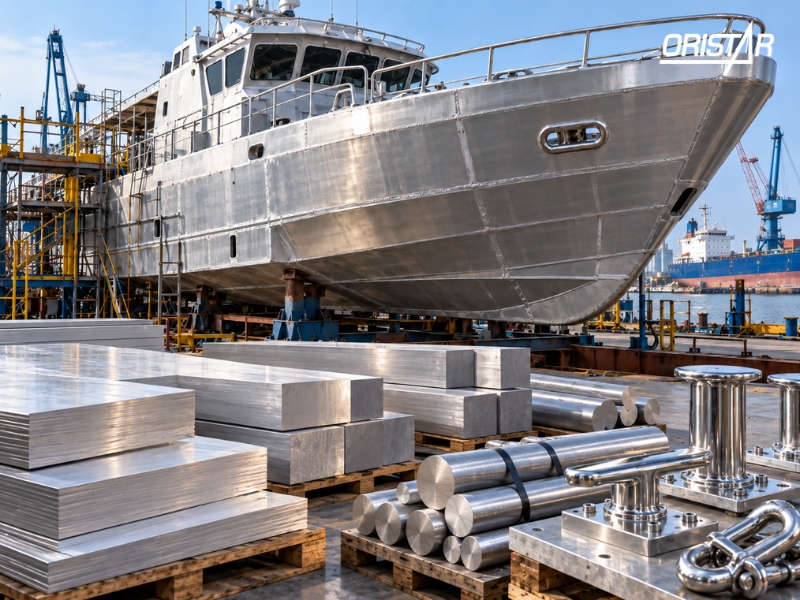
In our current shipbuilding portfolio we offer:
- SUS304;
- SUS303;
- SUS316L.
Among them, SUS316L is especially notable in applications requiring higher corrosion resistance.
Copper for marine electrical systems
C1100 is suitable for applications requiring high conductivity.
Can be used for:
- guide bar;
- electrical equipment;
- power connection;
- Power distribution system on board.
In the marine environment, in addition to electrical conductivity, special control is needed on the surface, the bonding method and the risk of electrochemical corrosion when copper comes into contact with other metals.
Materials for the automobile and motorbike industry
The automobile and motorbike industry simultaneously uses more groups of materials than most other transportation sectors. A modern vehicle may incorporate load-bearing steel, weight-reducing aluminum, conductive copper and many specialized alloys for connectors or friction components.
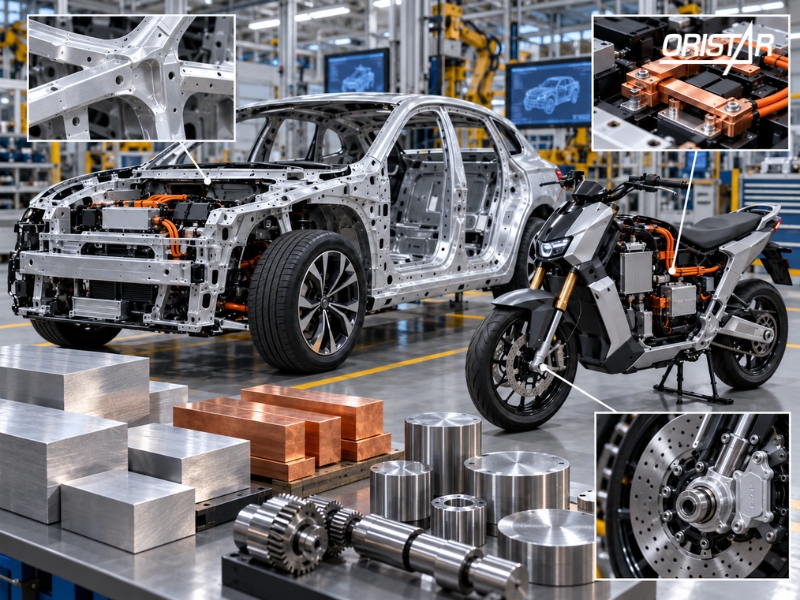
In the current catalog, we provide the automobile and motorbike industry with groups A1050, A2017, A5052, A6061, A7075; C1020, C1100, C1720, C2680, C5191; along with steel and stainless steel groups such as K340, SUS301, SUS303, SUS304 and W350.
Aluminum for structure and details reduces weight
Aluminum is increasingly used where it is necessary to reduce weight while maintaining the necessary strength.
Some applications may include:
- car body details;
- rack;
- device case;
- subframe;
- electric vehicle battery cover;
- engine block;
- mechanical details.
Oristar currently identifies A6061, A6063 and A5052 as brands with applications in chassis, wheels, battery housing and engine blocks.
However, each detail needs to be checked separately for:
- load;
- product form;
- welding ability;
- machinability;
- tolerance.
Copper in power systems and electric vehicles
Quá trình điện hóa khiến đồng trở thành một trong những nhóm vật liệu quan trọng nhất của xe thế hệ mới.
We focus on the following lines:
- C1100;
- C1020;
- C2680;
- C5191;
- C1720.
C1100 and C1020 are suitable for applications that require high conductivity such as:
- guide bar;
- electric motor;
- battery connection;
- power distribution system.
C2680 and C5191 can be selected for connectors or parts that require a balance between mechanical properties and electrical conductivity. C1720 is more suitable for positions requiring higher mechanical properties in the copper alloy group.
Thép và thép không gỉ
Thép vẫn giữ vai trò quan trọng ở:
- chi tiết chịu tải;
- dụng cụ;
- khuôn;
- các bộ phận yêu cầu độ cứng;
- chi tiết chống mài mòn.
Oristar Gia công và chuẩn bị vật liệu theo yêu cầu
Với các doanh nghiệp sản xuất phương tiện và linh kiện vận tải, việc mua vật liệu đúng mác mới chỉ là bước đầu. Quy cách phôi và mức độ chuẩn bị trước gia công ảnh hưởng trực tiếp đến thời gian sản xuất, hao hụt và tỷ lệ lỗi.
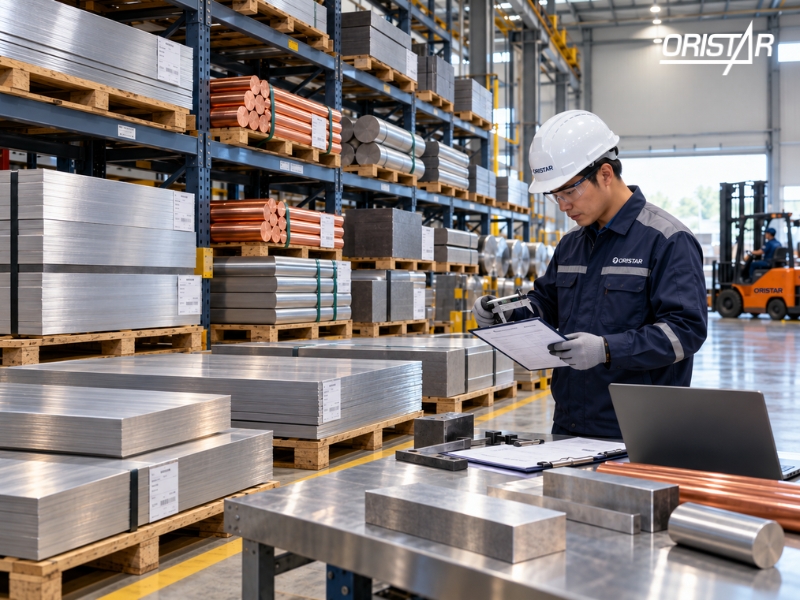
Tùy từng yêu cầu, chúng tôi hỗ trợ:
- cắt vật liệu theo quy cách;
- cắt theo kích thước yêu cầu;
- xẻ cuộn;
- chuẩn bị phôi;
- phay 4–6 mặt;
- kiểm soát kích thước;
- hỗ trợ gia công theo bản vẽ.
Khả năng cung cấp vật liệu kết hợp cắt và chuẩn bị phôi giúp khách hàng giảm bớt các công đoạn trung gian trước khi đưa vật liệu vào dây chuyền sản xuất.
Chứng từ và khả năng truy xuất vật liệu
Trong ngành vận tải, đặc biệt với sản xuất số lượng lớn, tính ổn định giữa các lô vật liệu có ý nghĩa rất lớn. Sai lệch về thành phần, cơ tính hoặc kích thước có thể ảnh hưởng trực tiếp tới quá trình gia công và chất lượng linh kiện.
Tùy yêu cầu của dự án, chúng tôi hỗ trợ kiểm tra các tài liệu như:
- CO, CQ
- chứng chỉ nhà máy
- thành phần hóa học
- cơ tính
- số lô
- tiêu chuẩn vật liệu
- hồ sơ truy xuất.
Oristar hiện cung cấp vật liệu phục vụ nhiều ngành sản xuất có yêu cầu về tiêu chuẩn, độ chính xác và tính ổn định giữa các lô.
Kết luận
Vật liệu ngành vận tải không thể lựa chọn theo một công thức chung. Đường sắt ưu tiên giảm trọng lượng, profile kết cấu và hệ thống điện; ngành hàng hải đặc biệt quan tâm tới chống ăn mòn và khả năng hàn; ô tô – xe máy lại yêu cầu cân bằng đồng thời giữa trọng lượng, độ bền, điện hóa và khả năng sản xuất hàng loạt.
Oristar - Cung cấp kim loại hàng đầu khu vực Châu Á
- Hotline: 098 875 06 86
- Email: info@oristar.vn
- Zalo OA
- Website E-commerce
- Official Website
Khuyến cáo (Disclaimer): Mọi thông số kỹ thuật và cơ lý tính trong bài viết chỉ mang tính chất tham khảo và có thể thay đổi tùy thuộc vào quy cách, trạng thái vật liệu và nhà sản xuất. Thông số này không thay thế cho các tiêu chuẩn sản xuất chính thức (JIS, ASTM...). Quý khách vui lòng liên hệ Oristar để nhận tư vấn chi tiết và chính xác nhất cho nhu cầu của mình.
Câu hỏi thường gặp
Phần dưới đây giải đáp những câu hỏi thường gặp khi lựa chọn vật liệu cho các lĩnh vực vận tải.
Vật liệu ngành vận tải gồm những loại nào?
Các nhóm kim loại chính gồm nhôm, đồng, hợp kim đồng, thép và thép không gỉ. Mỗi nhóm được sử dụng cho các mục đích khác nhau như kết cấu, giảm trọng lượng, dẫn điện, chống ăn mòn hoặc chịu tải.
Ngành đường sắt thường sử dụng vật liệu gì?
Tàu và toa xe có thể sử dụng nhôm cho thân, mái, sàn và các profile kết cấu; đồng cho hệ thống điện; thép và thép không gỉ cho các vị trí chịu tải hoặc chống ăn mòn.
Nhôm nào phù hợp cho ngành hàng hải?
A5083 là một trong những mác đáng chú ý nhờ khả năng chống ăn mòn nước biển, độ bền và khả năng hàn tốt. A5052 phù hợp hơn với nhiều chi tiết cần chống ăn mòn và tạo hình.
Oristar cung cấp vật liệu gì cho ngành ô tô – xe máy?
Danh mục hiện tại gồm các nhóm nhôm A1050, A2017, A5052, A6061, A7075; đồng C1020, C1100, C1720, C2680, C5191; cùng thép và thép không gỉ như K340, SUS301, SUS303, SUS304 và W350.
Có nên chọn vật liệu chỉ dựa vào độ bền không?
Không. Cần xét đồng thời tải trọng, môi trường làm việc, khả năng chống ăn mòn, phương pháp gia công, dạng sản phẩm và yêu cầu về trọng lượng.
Khi yêu cầu báo giá vật liệu ngành vận tải cần gửi gì?
Nên cung cấp lĩnh vực ứng dụng, tên chi tiết, mác hoặc tiêu chuẩn, dạng vật liệu, quy cách, số lượng, yêu cầu gia công và chứng từ cần thiết.