 vi
 en
 kr
 jp
 cn




The role of handrails in railway carriages
Handrails in railway cars are arranged at locations where passengers need a grip when standing or moving. Depending on the interior design, handrails can be installed vertically, horizontally, near the door, along the walkway or in the seating area.
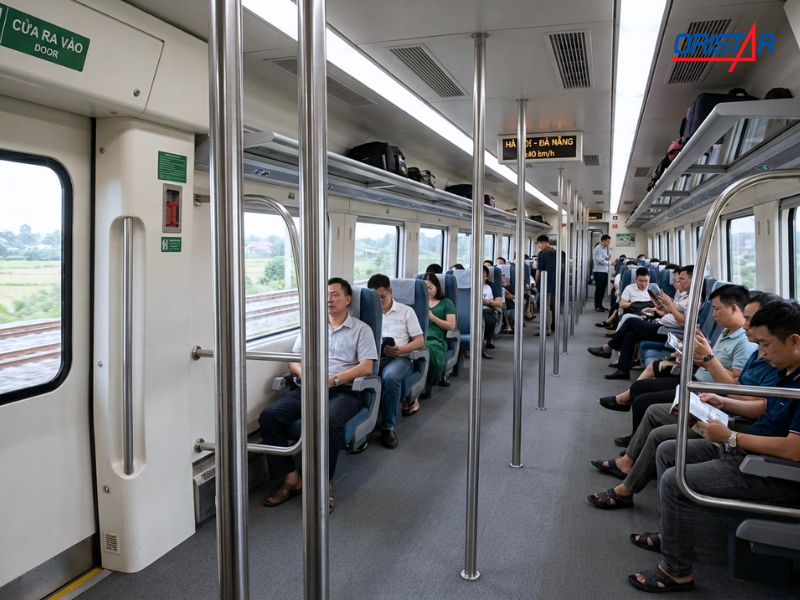
This department undertakes the following main functions:
- Create grip points for passengers:Helps passengers maintain balance when moving in the carriage.
- Transmission of force to fixed structures:Receives force from the grip and transmits it through the bracket, flange or connection element.
- Meets regular use needs:Contact surfaces should be suitable for handling and periodically cleaned.
- Suitable for interior layout:Size, shape and installation location need to be compatible with walkways, doors and surrounding equipment.
Handrails can be made from round stainless steel pipes, pipes with other cross-sections or assemblies combining many pipe sections and supports. Each design has its own requirements for size, bending radius, connection location and load. Therefore, materials need to be selected according to the function and drawing of each part.
Requirements for handrail materials in carriages
Handrail materials need to simultaneously meet the requirements of durability, corrosion resistance, surface quality and machinability. With stainless steel handrails, the quality of the finished product also depends on the cutting, bending, welding and surface treatment process.
Durability and rigidity
Handrails must meet the design load during use. Bearing capacity depends on stainless steel grade, outer diameter, pipe wall thickness, span length and support arrangement. Bending locations, welds and screw points should be inspected as they can affect the durability of the entire assembly.
Corrosion resistance
Handrails often come into contact with human hands and cleaning agents. Corrosion resistance depends on the stainless steel grade, usage environment, contact chemicals and surface finish quality. SUS304 can meet many common environments; SUS316 or SUS316L may be considered when service conditions require higher corrosion resistance.
Surface smoothness and quality
The handrail surface needs to be uniform, without burrs or sharp edges at the contact point. After cutting, bending or welding, parts should be inspected for scratches, deformation and joint areas. If the design calls for a matte or polished finish, the finishing method needs to be determined from the outset.
Machining ability
Stainless steel pipes can be cut, bent, welded and connected according to design. However, the forming ability depends on the steel grade, pipe wall thickness, bending radius and processing method. For handrails with many curved sections, it is necessary to control the cross-sectional deformation and size after bending.
Cleanability and maintenance
Pipe connection locations, bases and areas adjacent to walls should be designed to facilitate cleaning, inspection and maintenance. The right surface finish helps limit where dirt accumulates, while maintaining the handrail's usable condition.
The stainless steel grades Oristar provides can be considered for train handrails
Oristar announces a stainless steel portfolio with many grades to serve different industrial needs. However, not all brands have the characteristics and product types suitable for making handrails. With this part, priority should be given to corrosion resistance, formability, surface quality and drawing requirements.
Stainless steel grade | Main characteristics | Potential consideration for handrails |
SUS304 | Good corrosion resistance in many common environments; Can be machined and surface finished | Preferred option for evaluation of stainless steel handrails |
SUS316 | Molybdenum is added to increase corrosion resistance in some chloride containing environments | Consider when service conditions require higher corrosion resistance |
SUS316L | Variant with lower carbon content than SUS316, often of interest when welding and corrosion resistance in heat affected zones is required. | Consider material requirements and welding procedures |
SUS201 | Can help optimize material costs in some applications, but corrosion resistance differs from SUS304 | Only choose when the environment and technical requirements allow |
SUS301 | Can be supplied in material states with varying strength and formability characteristics | Only considered when material properties are suitable for specific design |
SUS303 | Improved machining and cutting capabilities | More suitable for mechanical processing details; Not the default choice for handrails |
SUS430 | Belongs to the ferritic stainless steel group, with different properties from the SUS304 group in terms of composition and corrosion resistance | Only considered when the design allows and the usage environment has been evaluated |
SUS420/420J2, SUS440/440C | Belongs to the martensitic stainless steel group, often of interest in details that require hardness or abrasion resistance | Not a priority group for regular handrails unless there are special requirements |
SUS304 is the option that should be evaluated first
SUS304 can meet many common requirements for handrails in railway carriages thanks to its corrosion resistance and relatively good machinability. This mark is suitable for inclusion in the initial assessment step when designing using stainless steel pipes and requiring an easy-to-clean surface.
However, choosing SUS304 is just the step to determine the material grade. Businesses still need to check the tube shape, diameter, wall thickness, surface condition and load-bearing requirements of the complete handrail.
When should you consider SUS316 or SUS316L?
SUS316 and SUS316L can be considered when handrails are working in environments with a higher risk of corrosion, such as frequent contact with chloride-containing cleaning agents or corrosive agents consistent with the characteristics of these two grades.
SUS316L has a lower carbon content than SUS316, so may be preferred in some designs that involve welding and require corrosion control in the weld zone. The choice between SUS304, SUS316 and SUS316L should be based on mining conditions, manufacturing processes and technical requirements of the project.
Criteria for selecting stainless steel pipes for handrails in railway carriages
After determining the stainless steel grade, businesses need to clarify pipe specifications and installation requirements. This is the basis for choosing the right input materials and limiting errors during the processing process.
Outside diameter and pipe wall thickness
The outer diameter affects the grip size, while the wall thickness is related to rigidity and bearing capacity. These two parameters need to be selected according to the design, distance between support points and expected load.
Handrail length and shape
Handrails can be straight sections, curved sections or clusters of many connected sections. The drawing should show the overall length, bending position, bending radius, turning angle and connector dimensions. This information determines the workpiece length and machining plan.
Fixed method
Handrails can be installed using flanges, brackets, gussets or separate connection structures. It is necessary to determine the number of fixed points, hole location and connection method to check the ability to transmit force. The strength of the handrail depends on both the stainless steel pipe, the connection details and the force-receiving structure.
Surface finishing required
The surface can be treated as matte, satin or polished depending on the design. In addition to appearance, it is necessary to check smoothness, scratches, burrs and welding areas. The finishing method needs to be consistent with the stainless steel grade and the hygiene requirements of the train car.
Supply specifications and material records
Order information must clearly state the stainless steel grade, product type, outer diameter, wall thickness, length and quantity. If the project requires material documents or specific standards, it is necessary to agree before ordering to check the correct specifications and handover documents.
Processing stainless steel train handrails
Stainless steel handrails often require many processing steps to achieve the designed shape and surface quality. The manufacturing plan needs to be consistent with the stainless steel grade, pipe specifications and required tolerances.
Steps may include:
- Cutting stainless steel pipes:Cut to the designed length, control the squareness of the section and remove burrs.
- Pipe bending:Shape according to radius and bending angle, control section deformation at curved positions.
- Pipe end processing:Create a connector or mounting surface according to a fixed plan.
- Welding details:Follow the process appropriate to the stainless steel grade, material thickness and structural requirements.
- Surface finishing:Treat welding areas, scratches and contact positions to meet smoothness requirements.
- Finished product inspection:Compare size, shape, connection position, surface condition and acceptance criteria.
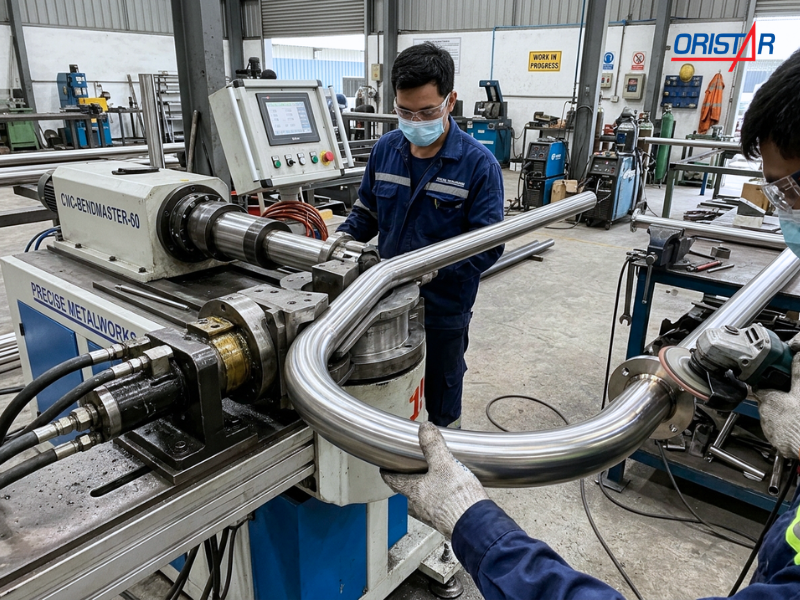
For handrails with many bends or connection points, the drawing should clearly show the overall size and location of the joints. Determining inspection criteria before machining helps limit deviations during installation and facilitates the acceptance process.
Oristar provides stainless steel according to marks and specifications
Oristar offers stainless steel in a variety of product forms, including sheets, coils, bars and tubes by category. The announced grades range from SUS201, SUS301, SUS303, SUS304 to SUS316, SUS316L, SUS420/420J2, SUS430 and SUS440/440C depending on the product group.
With the need to make train handrails, businesses should prioritize determining the correct type of pipe and material grade before requesting a quote. If the design uses round pipes, it is necessary to check the ability to provide the correct cross-section; If the drawing requires square tubes or other shapes, it is necessary to confirm the specific specifications instead of assuming that tube shapes are available in all grades.
Information to prepare when contacting Oristar includes:
- Required stainless steel grade, such as SUS304, SUS316 or SUS316L.
- Product form and pipe cross section.
- Outside diameter, wall thickness and length.
- Quantity and drawing of pipe bends, connectors or connection details.
- Surface requirements, material documents and quality checks.
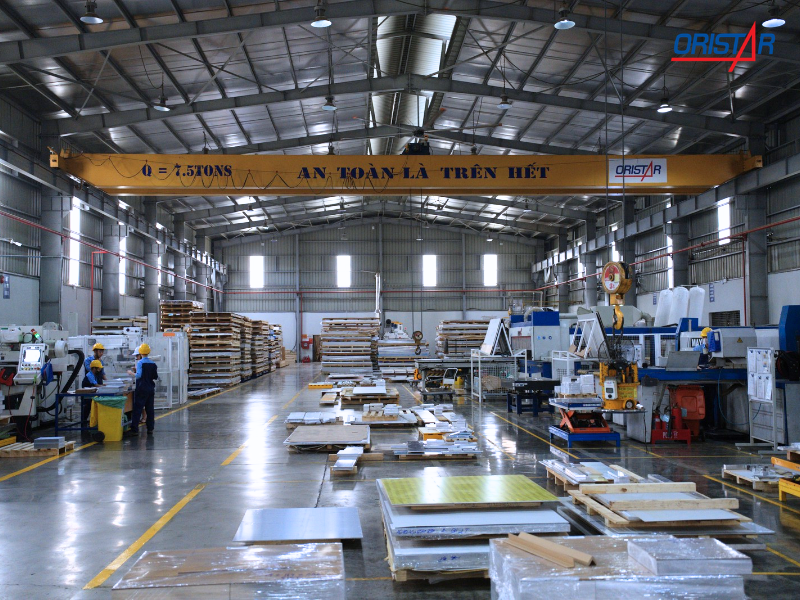
Oristar has metal processing services such as cutting to specifications and some forms of on-demand processing. The scope of implementation for stainless steel handrail pipes needs to be confirmed according to material labels, dimensions and actual drawings.
Oristar - Vietnam's leading metal and material solutions supplier
Disclaimer:All technical and mechanical specifications in the article are for reference only and may change depending on specifications, material status and manufacturer. This specification is not a substitute for official production standards (JIS, ASTM...). Please contact Oristar to receive the most detailed and accurate advice for your needs.