 vi
vi
 en
en
 kr
kr
 jp
jp
 cn
cn




The Role of Materials in the Electronics Industry
Materials are the foundation that determines the performance of electronic devices. Each type of material will bring different characteristics in terms of electrical conductivity, thermal conductivity, mechanical strength and corrosion resistance.
How do materials affect electronic device performance?
In electronic systems, conductive materials are responsible for transmitting current and signals between components. If the material has low or unstable electrical conductivity, transmission efficiency will decrease, causing energy loss and affecting product quality.
Besides, the thermal conductivity of the material also plays an important role in controlling the working temperature of the device. This is especially necessary for high-power electronic products such as power supplies, servers, telecommunications equipment or industrial control systems.
The relationship between materials and product life
Electronic devices often operate for long periods of time and are subject to environmental influences such as humidity, dust, or chemicals. Choosing materials with appropriate corrosion resistance and mechanical strength will help extend product life and reduce maintenance costs.
Why do electronic businesses need to choose the right materials right from the design stage?
Material costs often account for a large proportion of total production costs. Choosing the right materials from the beginning helps businesses limit technical risks, optimize product performance and ensure competitiveness in the market.
Technical Requirements for Materials in the Electronics Industry
Depending on each application, electronic materials will have different requirements. However, most modern electronic products need to meet the criteria below.
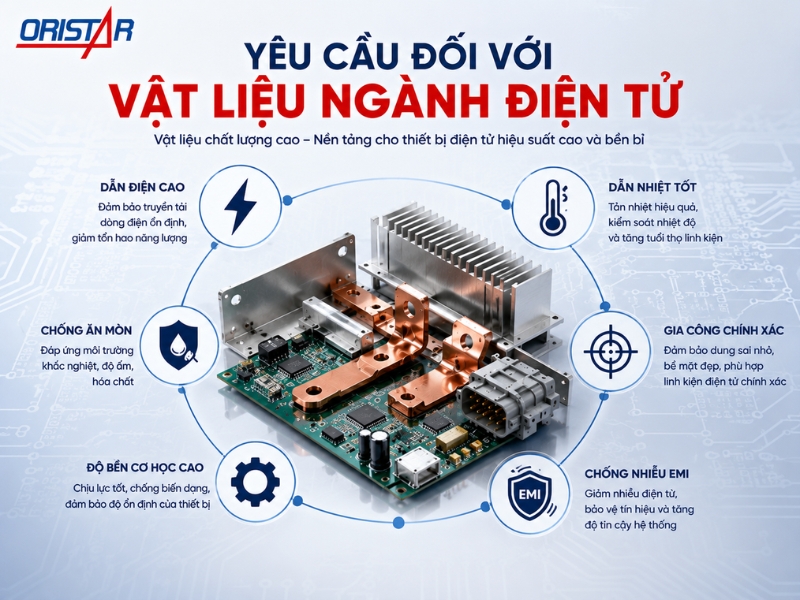
High electrical conductivity
Electrical conductivity is an important criterion for components such as connectors, terminals, busbars and conductive bars. Highly conductive materials help reduce energy loss and ensure stable signal transmission.
Good thermal conductivity
Temperature is one of the main causes of reducing the life of electronic components. Therefore, materials with good heat dissipation capabilities such as aluminum are often used to make radiators and device casings.
Dimensional stability
Modern electronic components have very tight tolerances. Materials need to ensure dimensional stability during processing and operation to maintain assembly accuracy.
Corrosion resistance
Production and operating environments may contain moisture or chemicals. Corrosion resistance helps equipment maintain performance and prolong service life.
Mechanical durability
The machine frame, racks and structural details need to have good bearing capacity to ensure the stability of the entire system.
Precision machining capabilities
Electronic parts often require CNC machining, stamping or milling with high precision. Materials need to have good machinability to meet technical requirements.
EMI Shielding
In modern electronic devices, anti-electromagnetic interference is an important factor to help ensure stable signals and improve system reliability.
Common Metal Materials in Electronics Industry
Copper, aluminum and stainless steel are three groups of materials widely used in the electronics industry thanks to their ability to meet many different technical requirements.
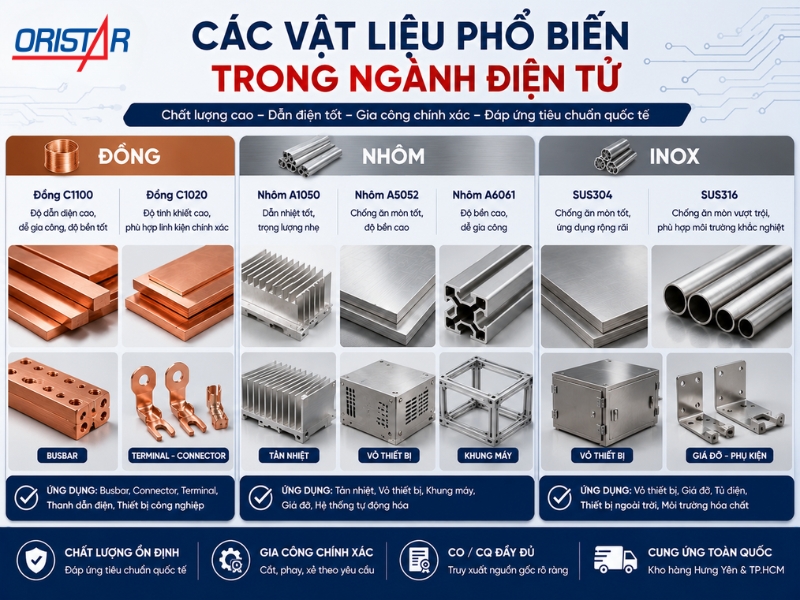
Copper C1100
C1100 copper is high purity copper, copper content reaches over 99.9%.
Outstanding advantages:
- High conductivity
- Good thermal conductivity
- Easy to process
- High stability
Application:
- Busbar
- Connector
- Terminal
- Conductor bar
- Industrial electrical equipment
Copper C1020
C1020 copper has higher purity and is often used in electronic applications that require great precision.
Advantage:
- Very high electrical conductivity
- Good purity
- Fits precision electronic components
Application:
- Signal connector
- Telecommunications equipment
- Precision electronic components
- Semiconductor equipment
Aluminum A1050
A1050 aluminum is a commonly used material in applications that require light weight and good thermal conductivity.
Application:
- Heat sink
- Electronic device case
- Lightweight conductive rod
- Renewable energy equipment
Aluminum A5052
A5052 stands out with good corrosion resistance and mechanical strength.
Application:
- Electronic case
- Control cabinet
- Device protection box
- Outdoor equipment
Aluminum A6061
A6061 is an aluminum alloy with high strength and good mechanical machinability.
Application:
- Electronic chassis
- Equipment rack
- Bearing structure
- Automation system
SUS304 stainless steel
SUS304 is widely used in structural parts requiring good corrosion resistance.
Application:
- Device case
- Rack
- Mechanical accessories
- Electrical cabinet
SUS316 stainless steel
SUS316 has outstanding corrosion resistance thanks to its molybdenum component.
Application:
- Outdoor electronic equipment
- Chemical environment
- Marine equipment
- Coastal solar energy system
What Electronic Devices Are Materials Used In?
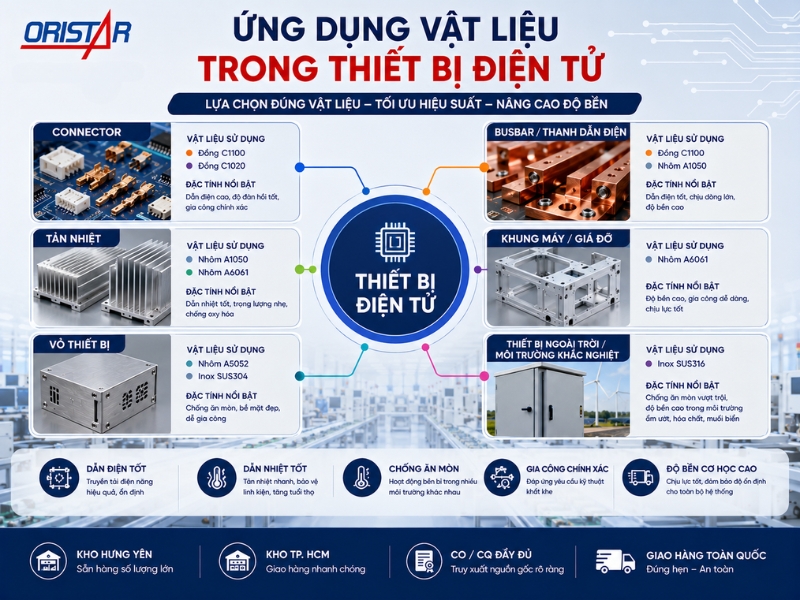
Depending on the function and technical requirements of each device, materials will be selected to optimize performance, durability and production costs.
Electronic equipment | Commonly used materials |
Connector | Copper C1100, Copper C1020 |
Terminal | Copper C1100 |
Busbar | Copper C1100, Aluminum A1050 |
Heat sink | Aluminum A1050, Aluminum A6061 |
Electronic chassis | Aluminum A6061 |
Device case | Aluminum A5052, SUS304 |
Telecommunications equipment | Copper C1020, Aluminum A6061 |
Electrical cabinet | A5052, SUS304 |
Outdoor equipment | SUS316 |
It can be seen that copper is often used in electrical transmission parts, aluminum is preferred for parts that need to reduce weight or dissipate heat, while stainless steel is suitable for applications that require high durability and corrosion resistance.
Comparison Table of Electronics Materials
Comparing technical characteristics helps businesses choose materials suitable for each specific application.
Material | Conductivity (%IACS) | Density (g/cm³) | Anti-corrosion | Mechanical durability | Main application |
Copper C1100 | 100 | 8.9 | Good | Good | Busbar, Connector |
Copper C1020 | 101 | 8.9 | Good | Good | Precision electronic components |
Aluminum A1050 | 61 | 2.71 | Good | Medium | Heat sink |
Aluminum A5052 | 35 | 2.68 | Very good | Good | Device case |
Aluminum A6061 | 43 | 2.70 | Good | High | Machine frame |
SUS304 | 2 | 7.93 | Very good | High | Racks, electrical cabinets |
SUS316 | 2 | 8.00 | Excellent | High | Outdoor equipment |
For applications requiring high conductivity, copper remains the optimal choice. Meanwhile, aluminum is preferred when it is necessary to reduce weight or increase heat dissipation. Stainless steel is suitable for environments with humidity or chemicals.
How to Choose Materials for the Electronics Industry According to Each Need
Material selection should not be based solely on cost but should consider overall technical requirements and operating conditions.
When Prioritizing Electrical Conductivity
For connectors, terminals, busbars or busbars, the material needs to have high conductivity to reduce energy loss and ensure a stable signal.
Suitable materials:
- Copper C1100
- Copper C1020
When Needing to Reduce Equipment Weight
Modern electronic products are increasingly moving towards more compact and lighter designs.
Suitable materials:
- Aluminum A1050
- Aluminum A6061
Application:
- Telecommunications equipment
- Heat sink
- Machine frame
- Renewable energy system
When Effective Heat Dissipation is Needed
High temperatures can shorten the life of electronic components. Therefore, materials with good thermal conductivity are preferred.
Suitable materials:
- Aluminum A1050
- Aluminum A6061
Application:
- Radiator
- Electronic device case
- Industrial control system
When Corrosion Resistance is Needed
For devices operating outdoors or in high humidity environments, corrosion resistance is an important factor.
Suitable materials:
- Aluminum A5052
- SUS304
- SUS316
When Cost Optimization is Needed
In many cases, choosing materials that balance performance and cost will bring better economic efficiency.
Suitable materials:
- Aluminum A5052
- Aluminum A6061
These are materials with good machinability, stable supply and lower costs than copper.
Materials Trends in Modern Electronics Industry
Technological developments are creating new requirements for electronic materials.
Electronic Devices Are Increasingly Compact
The miniaturization trend makes electronic components increasingly smaller but still must ensure high transmission efficiency and durability.
Heat Dissipation Needs for AI Server and Data Center
The development of AI and cloud computing increases the need to use materials that can dissipate heat effectively, especially aluminum and technical aluminum alloys.
Materials for Electric Vehicles (EV)
Electric vehicles require materials that are lightweight, conductive, and highly heat resistant to optimize battery and control system performance.
Materials for Renewable Energy
The solar and wind power industries are driving demand for aluminum, copper and stainless steel in large capacity power systems.
Materials Meet RoHS And REACH
Export businesses increasingly prioritize materials that meet environmental standards to comply with international market requirements.
Quality Standards in the Electronics Industry
Ngành điện tử là một trong những lĩnh vực có yêu cầu rất cao về chất lượng và khả năng truy xuất nguồn gốc vật liệu.
RoHS
Tiêu chuẩn kiểm soát hàm lượng các chất độc hại trong thiết bị điện và điện tử.
REACH
Quy định của châu Âu về quản lý hóa chất nhằm bảo vệ sức khỏe con người và môi trường.
ASTM
Hệ thống tiêu chuẩn quốc tế về vật liệu và thử nghiệm vật liệu.
JIS
Tiêu chuẩn công nghiệp Nhật Bản được áp dụng rộng rãi trong lĩnh vực điện tử và cơ khí chính xác.
EN
Bộ tiêu chuẩn kỹ thuật phổ biến tại thị trường châu Âu.
CO, CQ
CO chứng minh xuất xứ hàng hóa, trong khi CQ thể hiện chất lượng vật liệu đáp ứng các tiêu chuẩn công bố.
Giải Pháp Cung Cấp Vật Liệu Ngành Điện Tử Tại Oristar
Để đảm bảo chất lượng sản phẩm và tiến độ sản xuất, doanh nghiệp cần lựa chọn nhà cung cấp có năng lực cung ứng ổn định và đầy đủ chứng từ kỹ thuật.
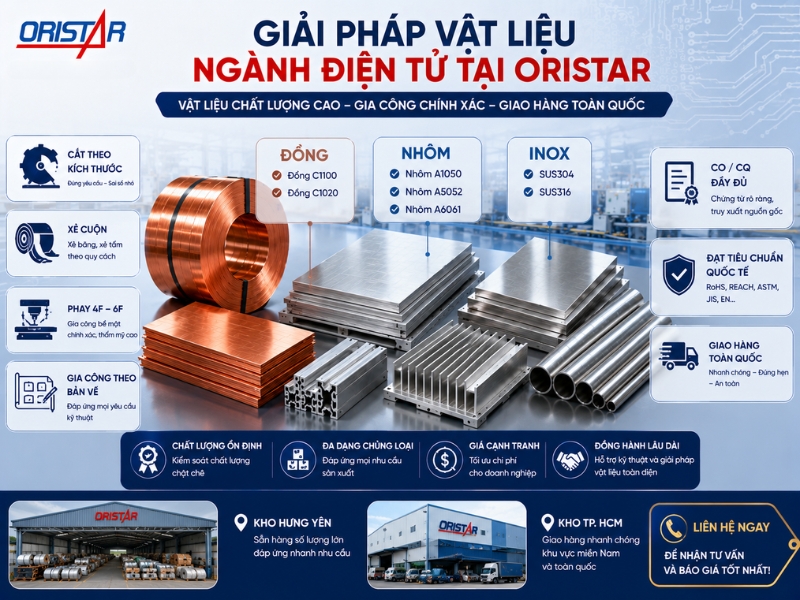
Oristar hiện cung cấp đa dạng vật liệu phục vụ ngành điện tử gồm đồng C1100, đồng C1020, nhôm A1050, nhôm A5052, nhôm A6061, inox SUS304 và inox SUS316.
Bên cạnh nguồn vật liệu đạt tiêu chuẩn quốc tế, Oristar còn cung cấp các dịch vụ gia công hỗ trợ như cắt theo kích thước, xẻ cuộn, phay 4F–6F và gia công theo bản vẽ (đối tác thứ ba) nhằm đáp ứng nhu cầu của các doanh nghiệp điện tử, điện công nghiệp và tự động hóa.
Với hệ thống kho tại Hưng Yên và TP.HCM cùng đầy đủ chứng từ CO, CQ, Oristar đáp ứng nhanh nhu cầu vật liệu cho khách hàng trên toàn quốc.
Kết Luận
Vật liệu ngành điện tử ảnh hưởng trực tiếp đến hiệu suất, độ bền và khả năng vận hành của thiết bị. Việc lựa chọn đúng vật liệu như đồng C1100, C1020, nhôm A1050, A5052, A6061 hoặc inox SUS304, SUS316 sẽ giúp doanh nghiệp tối ưu chất lượng sản phẩm và chi phí sản xuất.
Nếu bạn đang tìm kiếm vật liệu cho connector, terminal, busbar, tản nhiệt, khung máy hoặc vỏ thiết bị điện tử, hãy liên hệ Oristar để được tư vấn giải pháp phù hợp và nhận báo giá nhanh với đầy đủ CO/CQ.
Thông tin liên hệ:
- Hotline: 098 875 06 86
- Email: info@oristar.vn
- Zalo OA
- Website E-commerce
- Official Website
Khuyến cáo (Disclaimer): Mọi thông số kỹ thuật và cơ lý tính trong bài viết chỉ mang tính chất tham khảo và có thể thay đổi tùy thuộc vào quy cách, trạng thái vật liệu và nhà sản xuất. Thông số này không thay thế cho các tiêu chuẩn sản xuất chính thức (JIS, ASTM...). Quý khách vui lòng liên hệ Oristar để nhận tư vấn chi tiết và chính xác nhất cho nhu cầu của mình.