 vi
vi
 en
en
 kr
kr
 jp
jp
 cn
cn




2017 aluminum thin sheet has high durability and good cutting ability, suitable for many light structural parts, mounting plates and mechanical components. However, compared to A5052 or A6061, 2017 aluminum has more limited resistance to corrosion, welding, and forming. Therefore, businesses need to determine the correct T4 status, thickness, rolling direction, bending radius and surface protection plan before putting the material into production.
Is 2017 Aluminum Thin Sheet Suitable for Business Needs?
A2017 thin sheet is suitable for products that need better durability and cutting ability than common aluminum shapes. Aluminum 2017 is not the priority choice when parts require deep stamping, extensive welding or working directly in strongly corrosive environments.
Technical requirements | Appropriate level |
Lightweight structural panels bear the load | Fit |
Thin mounting plates and racks | Fit |
Precision mechanical components | Fit |
Cutting, drilling, milling, tapping | Very suitable |
Simple bending | Maybe, need to check the radius |
Deep stamping, creating complex shapes | No priority |
The structure needs a lot of welding | No priority |
Marine environment, chemicals | Need to protect the surface or change the label |
A2017 should be chosen when durability and machinability are key requirements. If the product prioritizes shaping or corrosion resistance, businesses should further compare with A5052, A5083 or A6061.
What is Aluminum 2017 Thin Sheet?
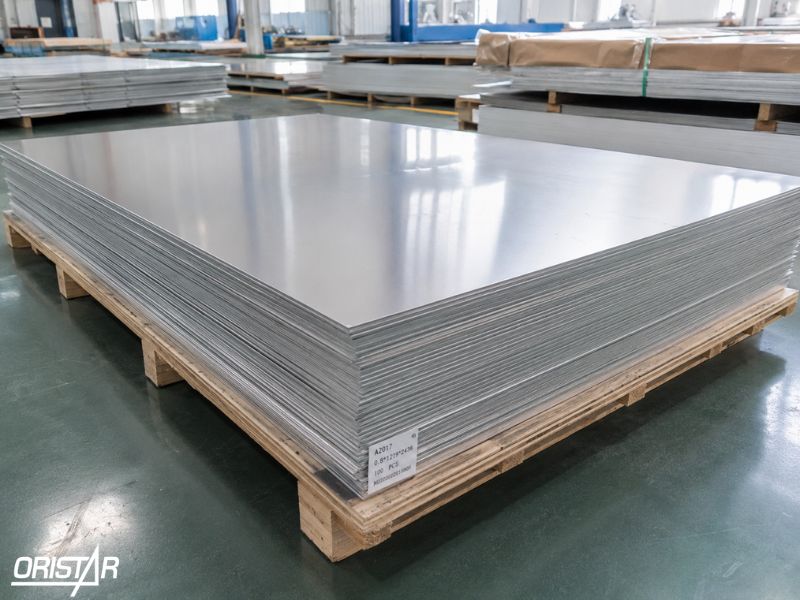
2017 aluminum thin sheet is a flat rolled product produced from 2xxx aluminum alloy, in which copper is an important alloying element. The material can be stabilized by heat, achieving higher durability than many common aluminum grades but has lower corrosion resistance than the 5xxx and 6xxx groups.
Features of A2017 thin panels include:
- High mechanical strength.
- Lighter weight than steel.
- Good milling, drilling and cutting.
- Suitable for load-bearing details.
- Bending ability depends on temper and thickness.
- Limited welding ability.
- Attention should be paid to surface treatment in corrosive environments.
The names A2017, AA2017 and EN AW-2017A may appear in different standards. When ordering, it is necessary to accurately compare the grade, composition, temper, mechanical properties and standards specified on the drawing.
How Are T4 And T451 Different?
Temper directly affects the durability, ductility, residual stress and bending ability of aluminum panels. For A2017 laminates, T4 is usually the state of greater interest; T451 should only be used when the product and material certificates clearly confirm it.
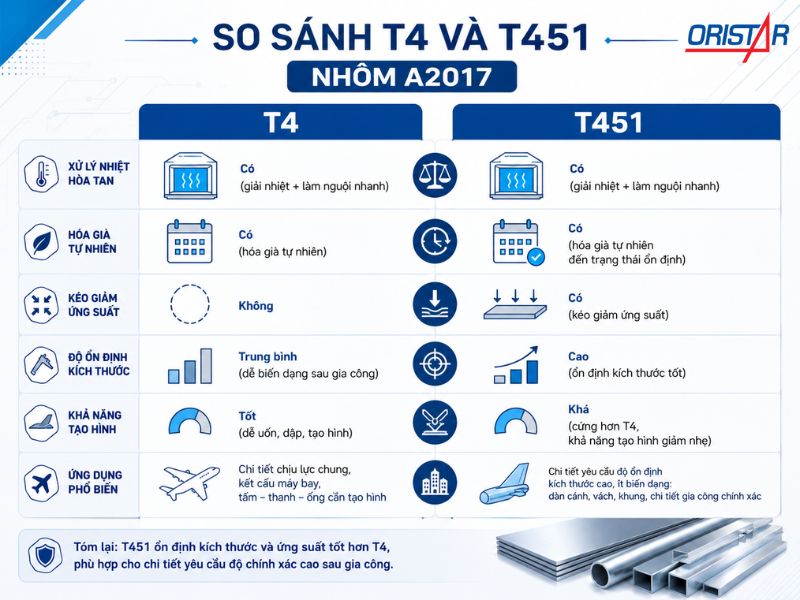
Criteria | A2017-T4 | A2017-T451 |
Dissolving heat treatment | Have | Have |
Aging naturally | Have | Have |
Pulling reduces stress | Not shown in symbols | Have |
Shaping ability | More suitable in many cases | Need to check according to specifications |
Used for thin sheets | More common | May be available depending on source |
Stability when machining | Good | Supports better stress control |
T451 does not mean the plate will not deform at all. The quality after processing also depends on the thickness, cutting method, amount of material removed, mounting method and production sequence. It is not recommended to manually replace T4 with T451 or vice versa if the drawing clearly specifies the material state.
What Thicknesses Does 2017 Aluminum Thin Sheet Have?
The A2017 thickness range depends on the manufacturer, standard, temper and source of goods at each time. Therefore, the website needs to clearly distinguish between the reference range and available specifications and products that must be ordered upon request.
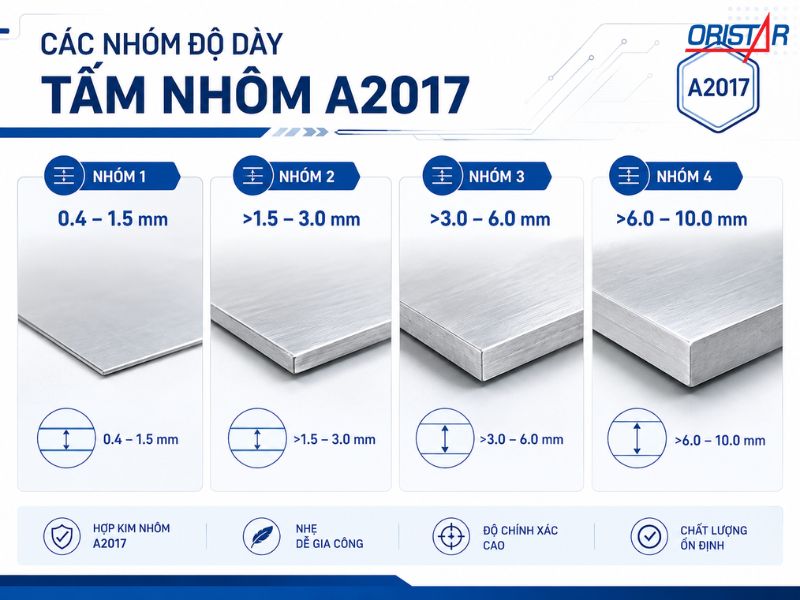
The following table can be used to organize product filters:
Thickness group | Temper reference | Supply status |
0.4–1.5 mm | T4 or in batches | Check inventory |
Over 1.5–3 mm | T4 or in batches | Available/to order |
Above 3–below 6 mm | T4, T451 if available | Confirm according to specifications |
Other thickness | Upon request | Order |
When requesting a quote, customers need to provide:
- Thickness.
- Width.
- Length.
- Temper.
- Origin.
- Quantity.
- Tolerance.
- Surface requirements.
- Cutting or machining service.
Do not take a production range from an international supplier to assume that Oristar always has all those thicknesses available.
Can A2017 Aluminum Thin Sheet Be Bendable?
A2017 can be bent or bent when choosing the right state and technological parameters. However, the material does not have the ability to be shaped as smoothly as A5052, so it is necessary to carefully check the bending radius, rolling direction and the risk of cracking on the outside of the bending line.
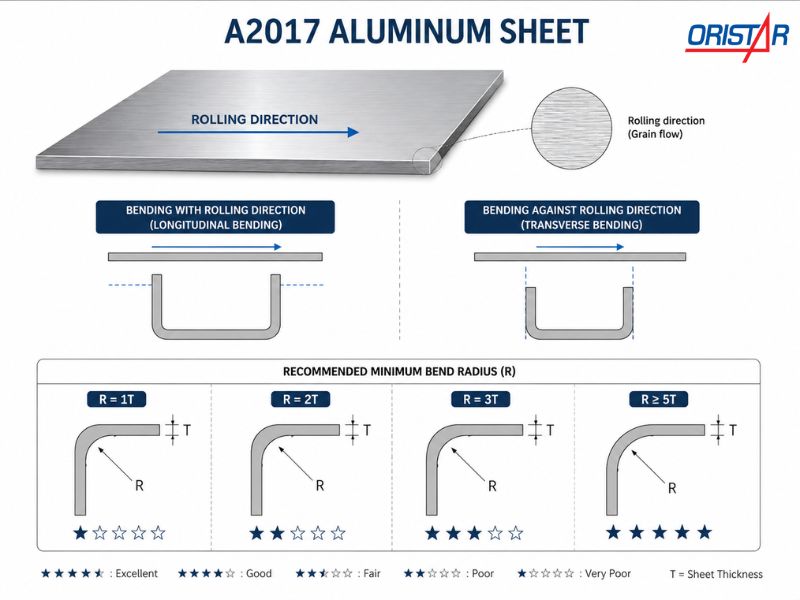
Factors to evaluate include:
- Plate thickness.
- T4 state or actual temper.
- Bending direction compared to rolling direction.
- Radius of pestle and mortar.
- Bending angle.
- Shock speed.
- Cutting edge quality.
- Requires post-shaping surface.
To limit cracking, businesses should:
- Avoid bending radius that is too small.
- Clean burrs before bending.
- Do not place a bad cutting edge in a high tension area.
- Check the rolling direction of the plate.
- Test samples before mass production.
- Use specifications from material standards or certificates.
The bending parameters of A5052 should not be directly applied to A2017 because the two alloys have different ductility and formability.
A2017 Thin Sheet Cutting, Punching and Machining Ability
A2017 has good machining and cutting capabilities, suitable for details that require edge cutting, hole drilling, groove milling or precision machining. The implementation method needs to be selected according to the thickness, tolerance and quantity of products.
Cut to size
Full-size panels can be cut into letter blanksaccording to the required width and length. Cutting close to finished product size helps:
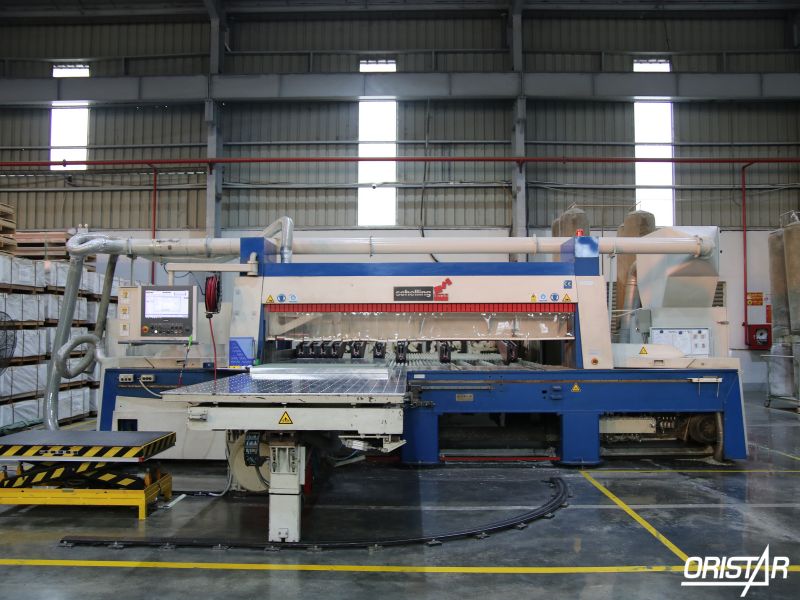
- Reduce residual material.
- Reduce preparation time.
- Limited inventory.
- Convenient for the next step.
- Classify workpieces by product code.
Punch and drill holes
A2017 thin panels can be punched or drilled with positioning holes, mounting holes and simple profiles. It is necessary to control the punch and die clearance, burrs, deformation around the hole and the distance from the hole to the edge of the plate.
Milling and CNC machining
Materials suitable for the following stages:
- Edge milling.
- Milling grooves.
- Wait.
- Taro.
- Machining shallow sockets.
- Cut the profile according to the drawing.
With thin parts, the mounting plan must limit bending of the plate. You can use a vacuum table, support plate or force distribution fixture depending on the product.
Corrosion Resistance and Surface Treatment
Due to its relatively high copper content, A2017 does not have the outstanding corrosion resistance of A5052, A5083 or A6061. Thin panels require even more attention because the cut edges and surfaces may come into direct contact with the environment.
Depending on usage conditions, the product may need:
- Protective paint.
- Surface conversion coating.
- Technical anodize.
- Anti-corrosion coating.
- Controls contact between dissimilar metals.
- Store in a dry environment.
For products requiring high aesthetics, it is necessary to test samples before anodizing because 2xxx system alloys may not create uniform surface color like some 6xxx system grades.
A2017 should not be described as material:
- Very good corrosion resistance.
- Directly suitable for sea water.
- As easy to solder as A5052.
- Always give the surface a beautiful decorative anodize.
Comparing A2017 Thin Plate With A5052, A6061 And A2024
Choosing thin panels requires a balance between durability, formability, machining, welding and corrosion resistance. The material with the highest durability is not necessarily the most suitable option for the entire production process.
Criteria | A5052 | A6061 | A2017 | A2024 |
Durability | Medium | Good | High | High |
Shaping ability | Very good | Rather | More limited than A5052 | Limit |
CNC machining | Good | Very good | Very good | Very good |
Anti-corrosion | Very good | Good | More limited | More limited |
Khả năng hàn | Very good | Tốt | Hạn chế | Hạn chế |
Lựa chọn chính | Vỏ, dập, chấn | Kết cấu, CNC | Chi tiết mỏng chịu tải | Kết cấu chịu mỏi |
Nên lựa chọn:
- A5052 khi ưu tiên chấn, dập và chống ăn mòn.
- A6061 khi cần cân bằng giữa gia công, hàn và độ bền.
- A2017 khi cần độ bền cao và khả năng cắt gọt tốt.
- A2024 khi khả năng chịu mỏi và tải trọng được đặt cao hơn.
Ứng Dụng Của Nhôm 2017 Tấm Mỏng
A2017 tấm mỏng phù hợp với các chi tiết cần giảm trọng lượng nhưng vẫn duy trì độ bền và độ cứng. Ứng dụng cuối cùng phải được xác định theo tiêu chuẩn thiết kế và môi trường làm việc.
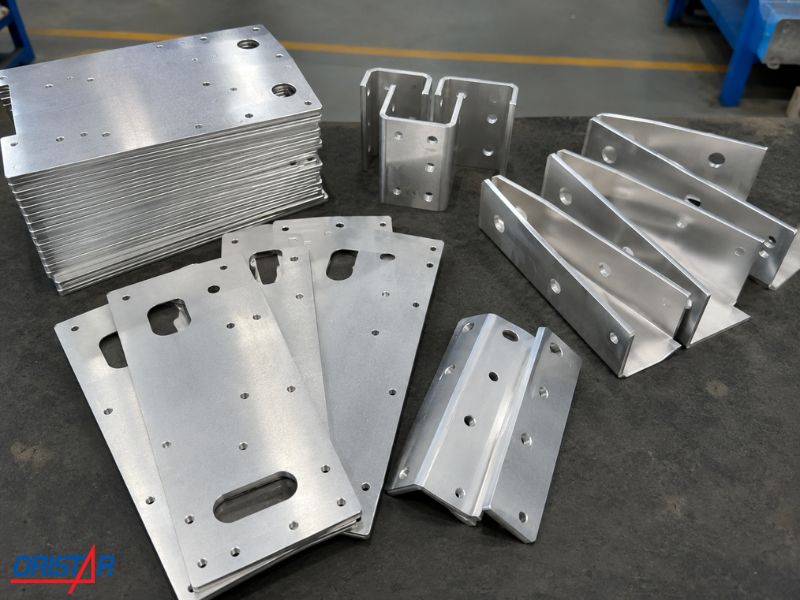
Một số ứng dụng thường gặp:
- Tấm kết cấu nhẹ.
- Giá đỡ mỏng.
- Tấm gá.
- Vách kỹ thuật.
- Tấm che chịu tải.
- Linh kiện cơ khí.
- Chi tiết thiết bị tự động hóa.
- Bộ phận phương tiện vận tải.
- Chi tiết có lỗ và rãnh chính xác.
- Linh kiện hàng không khi đáp ứng đúng tiêu chuẩn.
A2017 không nên được ưu tiên cho vỏ dập sâu, bồn chứa ăn mòn hoặc kết cấu phải hàn nhiều nếu chưa đánh giá đầy đủ yêu cầu kỹ thuật.
Oristar Nhận Cắt Nhôm 2017 Tấm Mỏng Theo Kích Thước
Cắt tấm theo quy cách sử dụng giúp doanh nghiệp giảm phế liệu và rút ngắn thời gian chuẩn bị vật liệu. Oristar hỗ trợ cắt nhôm tấm theo kích thước, dung sai và số lượng đã thống nhất.
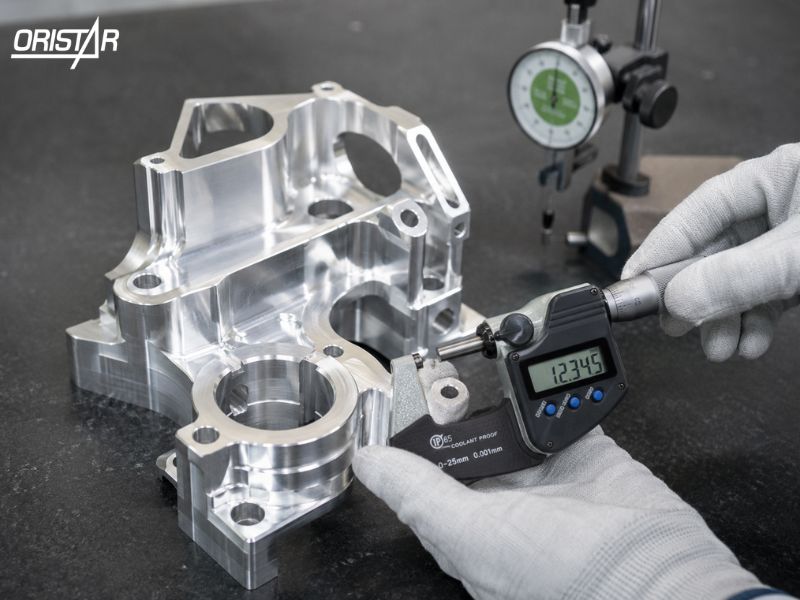
Thông số | Khả năng gia công tổng thể |
Chiều dày | 1–150 mm |
Chiều rộng | 12–3.600 mm |
Chiều dài | 12–4.000 mm |
Dung sai | Theo tiêu chuẩn Oristar hoặc yêu cầu |
Dịch vụ có thể bao gồm:
- Cắt tấm thành phôi.
- Cắt theo chiều rộng và chiều dài.
- Phân loại theo mã.
- Kiểm tra kích thước.
- Đóng gói theo lô.
- Chuẩn bị phôi cho công đoạn CNC.
Phạm vi trên thể hiện năng lực cắt tổng thể của thiết bị, không đồng nghĩa mọi độ dày, khổ tấm và temper A2017 đều luôn có sẵn.
Cách Tính Giá Nhôm 2017 Tấm Mỏng Tại Oristar
Giá A2017 tấm mỏng được xác định theo cấu hình sản phẩm thay vì áp dụng một mức cố định cho mọi quy cách. Khách hàng lựa chọn trạng thái, xuất xứ, nhập kích thước và số lượng để hệ thống tính giá hoặc gửi yêu cầu xác nhận.
Thông tin cần nhập gồm:
Thông tin | Nội dung |
Mác vật liệu | A2017 hoặc 2017A |
Trạng thái | T4 hoặc temper thực tế |
Xuất xứ | Theo lựa chọn đang cung cấp |
Chiều dày | mm |
Chiều rộng | mm |
Chiều dài | mm |
Số lượng | Tấm hoặc phôi |
Gia công | Cắt, đột, khoan hoặc CNC |
Quy trình thực hiện:
- Chọn mác A2017.
- Chọn trạng thái vật liệu.
- Chọn xuất xứ.
- Nhập chiều dày, chiều rộng và chiều dài.
- Nhập số lượng.
- Xem giá hoặc gửi yêu cầu xác nhận.
Chi phí đột, chấn, phay hoặc CNC theo bản vẽ cần được báo riêng theo độ phức tạp và dung sai của sản phẩm.
Cần Cung Cấp Gì Để Nhận Báo Giá Chính Xác?
Báo giá chính xác cần đầy đủ thông tin về vật liệu và phạm vi gia công. Chỉ gửi tên “nhôm 2017 tấm mỏng” chưa đủ để xác định đúng sản phẩm.
Khách hàng nên chuẩn bị:
- Mác A2017 hoặc 2017A.
- Trạng thái T4 hoặc temper yêu cầu.
- Chiều dày.
- Chiều rộng.
- Chiều dài.
- Số lượng.
- Dung sai.
- Yêu cầu bề mặt.
- Phương án cắt hoặc gia công.
- Bản vẽ nếu có.
- Chứng từ cần cung cấp.
- Thời gian nhận hàng.
Kết Luận
Nhôm 2017 tấm mỏng là lựa chọn phù hợp cho những chi tiết cần độ bền cao, trọng lượng nhẹ và khả năng gia công cắt gọt tốt. Tuy nhiên, doanh nghiệp cần đánh giá kỹ trạng thái T4, bán kính uốn, khả năng chống ăn mòn và phương án bảo vệ bề mặt. Với công cụ tìm kiếm – tính giá theo quy cách cùng năng lực cắt và gia công theo yêu cầu, Oristar hỗ trợ khách hàng lựa chọn đúng A2017 tấm mỏng, tối ưu kích thước phôi và giảm thời gian chuẩn bị cho sản xuất.
Thông tin liên hệ:
- Hotline: 098 875 06 86
- Email: info@oristar.vn
- Zalo OA
- Website E-commerce
- Official Website
Khuyến cáo (Disclaimer): Mọi thông số kỹ thuật và cơ lý tính trong bài viết chỉ mang tính chất tham khảo và có thể thay đổi tùy thuộc vào quy cách, trạng thái vật liệu và nhà sản xuất. Thông số này không thay thế cho các tiêu chuẩn sản xuất chính thức (JIS, ASTM...). Quý khách vui lòng liên hệ Oristar để nhận tư vấn chi tiết và chính xác nhất cho nhu cầu của mình.