 vi
vi
 en
en
 kr
kr
 jp
jp
 cn
cn




Aluminum for aircraft fuselage does not have just one grade. The outer shell, stiffeners, ring frames, window frames, door frames or pressure walls are all subjected to different types of loads during operation. Therefore, each position needs a unique balance between durability, fatigue resistance, failure toughness, corrosion resistance and weight. In reality, alloys such as A2024, A2524, A7075, A7050 or A7475 can be found in different structures of the fuselage. Aerospace application data also shows that the body shell, trim, ring frame and areas around the doors do not use the same material group.
Why can't the fuselage use just one type of aluminum?
From the outside, the fuselage may resemble a large metal tube. But structurally, this is a system of many parts working together to hold shape, bear loads and maintain cavity tightness.
When the aircraft operates, the body must simultaneously withstand many types of loads such as:
- Tensile and compressive loads due to bending of the body;
- vibrations during takeoff, flight and landing;
- repeated loading over thousands of mining cycles;
- pressure difference between the aircraft cabin and the outside environment;
- The load is concentrated in the door, window and connection areas.
In particular, with aircraft with pressurized compartments, each flight cycle creates a cycle of increasing and decreasing pressure. This makes fatigue resistance and crack growth control very important criteria for aircraft fuselage materials.
NASA aviation documents have noted that A2024 is widely used for applications that require good damage resistance such as body shells, while A7075 often appears in locations that require higher strength.
So the right question is not just: “What aluminum is used in the fuselage?” but need to go deeper: "Which part of the fuselage is in need of material and what kind of load is that part subjected to?"
What main parts does the fuselage consist of?
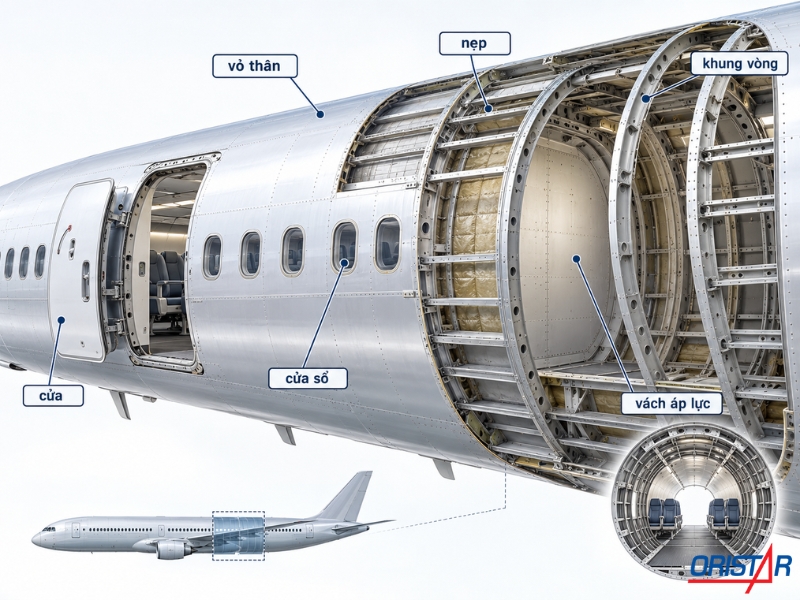
Fuselage shell
The fuselage is the outer metal layer surrounding the aircraft cabin. In addition to the task of creating aerodynamic shapes, the shell also participates in bearing the load along with the internal frame and brace system.
For passenger aircraft, the fuselage must also work in pressure conditions that change repeatedly with each flight. Therefore, the material used for the shell not only needs to be durable but also must be able to withstand fatigue and limit the development of cracks.
Body brace
Splints are reinforcing bars that run along the fuselage of the aircraft.
They help:
- increase the hardness of the shell;
- limit shell instability;
- longitudinal body load transmission;
- Combined with ring frames to form a load-bearing structural system.
Body frame
The ring frame is arranged along the circumference of the fuselage.
They help:
- keep the cross-sectional shape of the body;
- load distribution;
- shell and brace support;
- Create links with other structures.
Window frame
Windows create openings in the shell that is already carrying loads. Therefore, the area around the window needs to be reinforced to redistribute stresses and limit load concentration.
Door frame
Doors are larger in size than windows, so they affect the body's load transmission path more.
This area often needs:
- reinforced frame;
- Highly durable materials;
- good toughness;
- Ability to work stably for a long time.
Pressure wall
The pressure wall helps maintain the boundaries of the pressurized chamber and bears the load due to the pressure difference. This is one of the positions that requires high durability and ability to withstand repeated loads.
What type of aluminum is used for each fuselage part?
There is no single bill of materials applicable to all aircraft models. However, aerospace application data shows that the following alloy groups may be encountered:
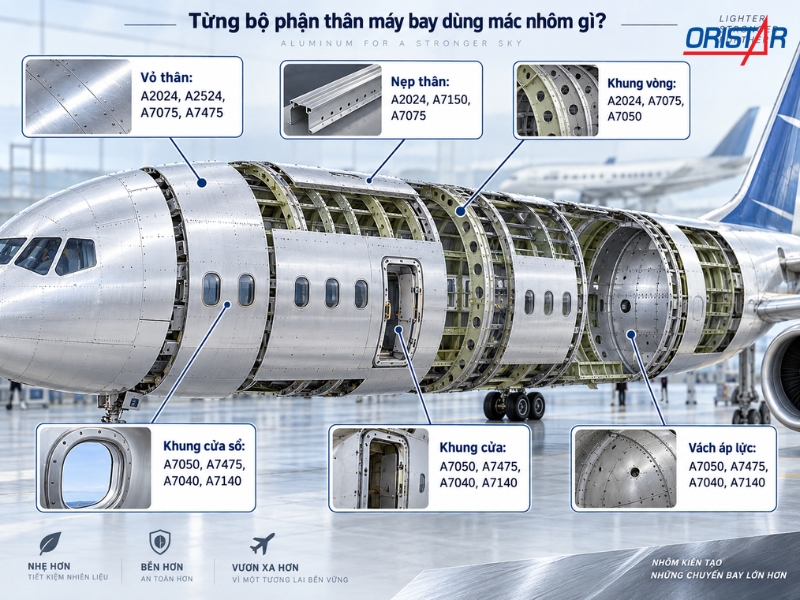
Part | Main requirements | Some aluminum grades may be encountered |
Body shell | Fatigue resistant, limited crack development, lightweight | A2024, A2524, A7075, A7475, A6056, A6156 |
Body brace | High hardness and durability | A2024, A7150, A7075 |
Ring frame | Bearing force, keeping shape stable | A2024, A7075, A7050 |
Window frame | Durability, toughness, ability to withstand concentrated loads | A7050, A7475, A7040, A7140 |
Door frame | High load capacity, good toughness | A7050, A7475, A7040, A7140 |
Hinge and door structure | Lightweight, precision machined | F357, AlSiMg0.6 |
Pressure wall | Resistant to repeated loads and pressures | A7050, A7475, A7040, A7140 |
The above marks reflect the clear differences between each position on the fuselage.
It is important not to interpret this table as "label A is always used for part B". The actual choice depends on the aircraft design, thickness, heat treatment state, material type and manufacturer's technical standards.
Why is A2024 used a lot for aircraft fuselage?
A2024 belongs to the aluminum-copper alloy group and is one of the brands with a long history of use in the aviation industry. The important advantage of A2024 lies not only in its durability but also in its fatigue resistance.
The fuselage must go through many cycles: pressurize → maintain pressure → depressurize → repeat. If the material does not have a good ability to withstand repeated loads, small defects or stress concentration areas can develop into cracks after long periods of service.
Oristar also currently classifies A2024 as a material with good fatigue resistance and is used in aerospace structures. NASA has recorded that A2024 is in a suitable state to be used in applications that do not require the highest strength but need good damage tolerance, typically the fuselage shell.
This is why A2024 is still one of the important grades when it comes to aluminum for aircraft fuselages.
How is A2524 different from A2024 when used as a body shell?
A2524 is a clear example of how the aviation industry does not stop at using traditional alloys but continuously improves materials to increase structural longevity.
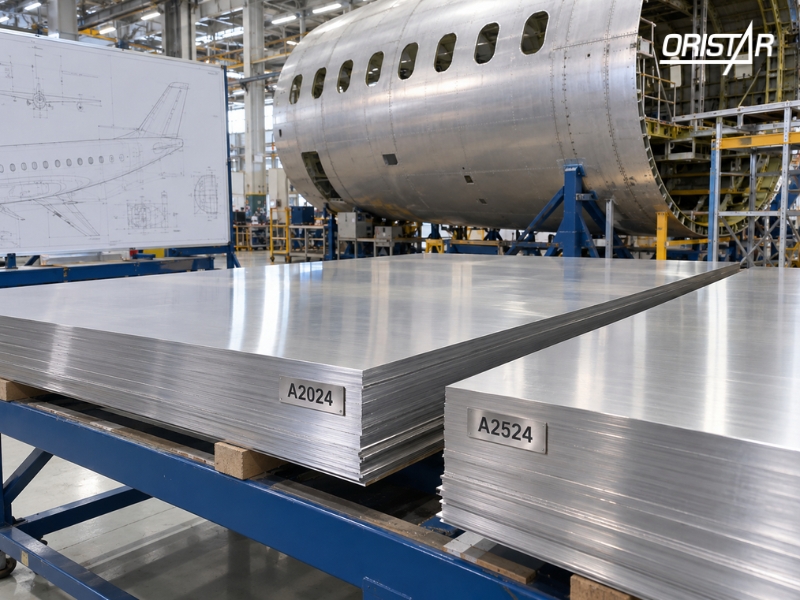
A2524-T3 was developed to improve damage tolerance and crack growth resistance compared to A2024-T3.
A study hosted by NASA shows that under pre-corrosion test conditions, sample 2524-T3 has higher fatigue strength and longer time to failure than 2024-T3; The study also highlighted the advantages of 2524 in terms of crack growth resistance and failure toughness.
Other studies have also identified A2524-T3 as a body shell material being developed to replace or improve performance compared to A2024-T3 in certain aerospace applications. Therefore, when it comes to aluminum for aircraft fuselage, just mentioning A2024 is not enough. A2524 clearly shows the direction of material development:
Not only does it need to be durable, but it also needs to better control the process of crack formation and development.
Why is A7050 suitable for frames and load-bearing structures?
A7050 belongs to the high strength 7xxx alloy group.
The notable point of A7050 is its ability to maintain good mechanical properties in thicker sections, while combining:
- high durability;
- toughness;
- Better resistance to stress corrosion cracking in suitable conditions.
These are characteristics that are consistent with structural details such as:
- body frame;
- load-bearing walls;
- thick plate details;
- Structures need to be machined from large billets.
A7050 is an alloy suitable for thick plate applications and lists fuselage frames, bulkheads and wing skins among typical applications. This is also consistent with Oristar's industry data, where A7050 appears in body ring frames, door frames and pressure walls.
Where on the fuselage is the A7075 used?
A7075 is one of the most famous high strength aluminum alloys in the 7xxx group.
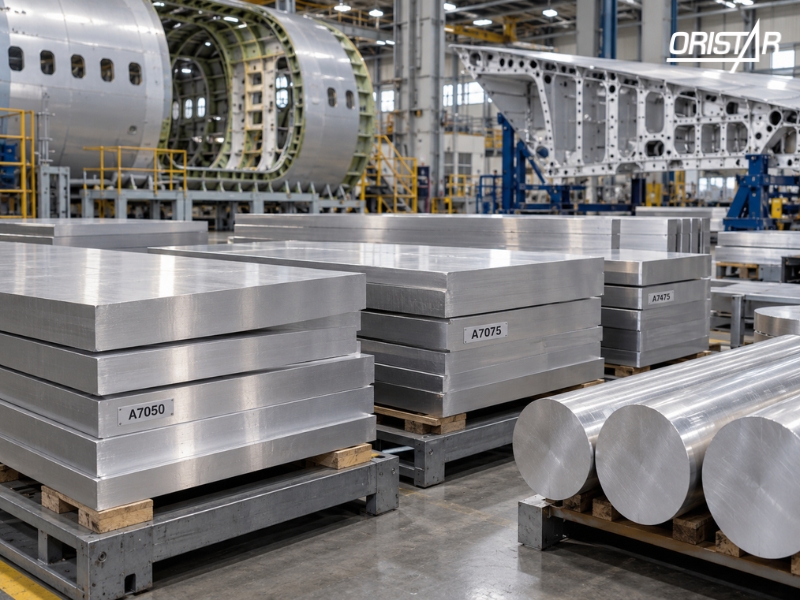
Main advantages:
- high mechanical strength;
- Good strength-to-weight ratio;
- good mechanical processing ability;
- Suitable for many high load structures.
In the fuselage structure data, the A7075 can be found at:
- stem bark;
- body brace;
- ring frame;
- some nasal texture;
- other load-bearing positions.
Oristar offers the A7075 for aerospace and high-load structural applications. However, it should not be understood that if you need high durability, you should choose A7075.
In aircraft fuselage design, fatigue resistance, failure toughness and stress corrosion resistance are sometimes as important as tensile strength. That's why A7075 is not the only material used.
What is different about the A7475 when used for skins and airframes?
The A7475 also belongs to the 7xxx family and has many similarities with the A7075. However, one advantage that is often emphasized in the A7475 ishigh destructive toughness.
This is a very important characteristic for aerospace structures because a detail must not only be durable enough to not deform but also need to limit the risk of cracks developing quickly leading to destruction.
Suppliers of specialized aerospace materials note that A7475 is used frequently for aircraft fuselage skins and has a higher failure toughness than A7075 in suitable product forms and conditions.
Oristar's application data also shows the A7475 appearing at:
- stem bark;
- window frames;
- door frame;
- pressure wall.
This is an example of how aerospace material selection cannot be based solely on tensile strength tables.
Why do door and window areas have to use different materials?
Think of the fuselage as a continuous load-bearing tube. When creating a window or a door, that continuous structure is interrupted. The capital load distributed on the shell must bypass the opening.
This creates areas that require special control of:
- stress concentration;
- deformation;
- hardness;
- bond strength;
- resistance to crack development.
The doors are large in size so the reinforcement requirements are even higher.
This is why material data shows that the door frame and window areas use more 7xxx alloys such as A7050, A7475, A7040 and A7140 instead of just using the same sheet as the surrounding shell.
In other words:The fuselage shell and door frame are located on the fuselage but do not perform the same structural function.Therefore material requirements are also different.
What type of aluminum is needed for pressure walls?
The pressure wall is responsible for carrying and distributing the load related to the pressure difference in the cavity. This is a detail that must be worked on repeatedly throughout the aircraft's life cycle.
Materials at this location need to be balanced:
- intensity;
- toughness;
- fatigue tolerance;
- resistance to crack development;
- long-term stability.
In the application data, groups A7050, A7475, A7040 and A7140 appear on the front pressure wall. This is also a group of materials often chosen for high-load aerospace structures instead of just using a common grade.
Is A2024 or A7075 better for the fuselage?
There is no better mark for the entire fuselage.
The two materials solve different problems.
The A2024 usually stands out when needed
- good fatigue resistance;
- work under repeated loads;
- sheet material for shell;
- suitable damage tolerance.
The A7075 often stands out when needed
- very high intensity;
- high hardness;
- good strength-to-weight ratio;
- các kết cấu chịu tải lớn.
If we look more broadly, there are also:
A2524
Tập trung cải thiện khả năng chịu hư hỏng và kiểm soát phát triển vết nứt cho các ứng dụng vỏ thân.
A7050
Phù hợp với nhiều kết cấu dày, khung và vách chịu lực nhờ sự cân bằng giữa cường độ, độ dai và khả năng chống nứt do ăn mòn ứng suất.
A7475
Nổi bật ở độ dai phá hủy cao và có ứng dụng trong vỏ thân máy bay. Do đó, trong thiết kế hàng không: không có “mác mạnh nhất” — chỉ có mác phù hợp hơn với từng vị trí và dạng tải.
Có phải toàn bộ thân máy bay hiện đại đều làm bằng nhôm?
Không. Nhôm vẫn là vật liệu kết cấu quan trọng trong ngành hàng không, nhưng máy bay hiện đại có thể kết hợp nhiều loại vật liệu như:
- hợp kim nhôm;
- vật liệu composite;
- titan;
- thép tại một số chi tiết;
- vật liệu laminate trong những thiết kế nhất định.
Ví dụ, vật liệu GLARE kết hợp các lớp nhôm A2024-T3 với sợi thủy tinh đã được nghiên cứu và ứng dụng cho kết cấu vỏ thân nhằm cải thiện khả năng chống phát triển vết nứt mỏi.
Vì vậy, không nên hiểu “thân máy bay” đồng nghĩa với “100% nhôm”. Tuy nhiên, các hợp kim nhôm 2xxx và 7xxx vẫn đóng vai trò rất quan trọng trong nhiều thiết kế thân máy bay.
Khi chọn nhôm cho chi tiết thân máy bay cần quan tâm những gì?
Tên mác chỉ là bước đầu tiên. Một yêu cầu kỹ thuật đầy đủ thường cần xác định thêm:
Trạng thái nhiệt luyện
Ví dụ cùng A7075 nhưng T6, T651 hay T73 có thể có cơ tính và khả năng chống ăn mòn ứng suất khác nhau.
Dạng vật liệu
Có thể là:
- tấm mỏng;
- plate;
- thanh;
- extrusion;
- forging.
Mỗi dạng có đặc tính và ứng dụng riêng.
Chiều dày
Cơ tính và khả năng làm việc của hợp kim có thể thay đổi theo chiều dày và dạng bán thành phẩm.
Hướng vật liệu
Với chi tiết hàng không chịu tải cao, hướng cán và hướng lấy phôi so với tải có thể là yếu tố cần được quy định trong bản vẽ.
Tiêu chuẩn
Không nên chỉ đặt: “A7075, dày 30 mm”.
Mà cần kiểm tra đầy đủ:
- tiêu chuẩn vật liệu;
- temper;
- dung sai;
- quy cách;
- yêu cầu cơ tính;
- yêu cầu bề mặt;
- chứng từ lô hàng.
Kích thước phôi và lượng dư
Nếu chi tiết cần CNC, việc chọn phôi quá lớn có thể làm:
- tăng lượng vật liệu phải bóc;
- tăng thời gian máy;
- tăng chi phí;
- tăng nguy cơ biến dạng khi gia công.
Do đó việc chuẩn bị phôi đúng ngay từ đầu có vai trò rất quan trọng.
Oristar cung cấp nhôm kỹ thuật cho các chi tiết yêu cầu độ bền cao
Oristar hiện cung cấp nhiều dòng nhôm kỹ thuật phục vụ cơ khí chính xác và các ngành yêu cầu cao như:
- A2024;
- A6061;
- A7075;
- cùng các mác nhôm khác theo danh mục thực tế.
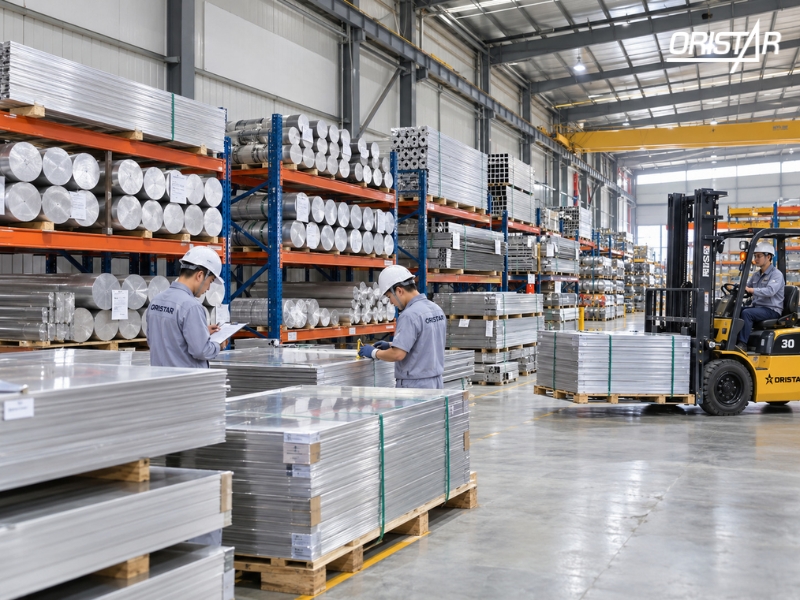
Trong đó, A2024 được đánh giá cao về khả năng chịu mỏi, còn A7075 nổi bật với cường độ cơ học rất cao và khả năng gia công tốt.
Ngoài cung cấp vật liệu, doanh nghiệp còn có thể kết hợp các công đoạn chuẩn bị phôi như:
- cắt theo kích thước;
- cắt theo bản vẽ;
- phay 4–6 mặt;
- kiểm soát kích thước phôi;
- chuẩn bị lượng dư phù hợp trước CNC.
Với các yêu cầu liên quan đến chi tiết hàng không, doanh nghiệp nên gửi đầy đủ: mác vật liệu + temper + tiêu chuẩn + quy cách + số lượng + bản vẽ hoặc yêu cầu gia công
để kiểm tra khả năng cung ứng chính xác.
Kết luận
Nhôm làm thân máy bay không chỉ có A2024 hay A7075. Vỏ thân, nẹp, khung vòng, khu vực cửa và vách áp lực đều thực hiện những nhiệm vụ kết cấu khác nhau nên yêu cầu về vật liệu cũng khác nhau.
A2024 và A2524 phù hợp với nhiều ứng dụng cần khả năng chịu mỏi và kiểm soát phát triển vết nứt; A7075 mang lại cường độ cao; trong khi A7050 và A7475 được sử dụng ở những vị trí cần sự cân bằng tốt giữa độ bền, độ dai và khả năng làm việc lâu dài. Vì vậy, khi lựa chọn nhôm cho thân máy bay, không nên chỉ hỏi “mác nào bền nhất”. Điều quan trọng hơn là xác định đúng bộ phận, dạng tải, trạng thái vật liệu, tiêu chuẩn và hình thái sản phẩm trước khi lựa chọn mác phù hợp.
Oristar - Cung cấp kim loại hàng đầu khu vực Châu Á
- Hotline: 098 875 06 86
- Email: info@oristar.vn
- Zalo OA
- Website E-commerce
- Official Website
Khuyến cáo (Disclaimer): Mọi thông số kỹ thuật và cơ lý tính trong bài viết chỉ mang tính chất tham khảo và có thể thay đổi tùy thuộc vào quy cách, trạng thái vật liệu và nhà sản xuất. Thông số này không thay thế cho các tiêu chuẩn sản xuất chính thức (JIS, ASTM...). Quý khách vui lòng liên hệ Oristar để nhận tư vấn chi tiết và chính xác nhất cho nhu cầu của mình.