 vi
vi
 en
en
 kr
kr
 jp
jp
 cn
cn




What is stainless steel coil?
Coiled stainless steel is stainless steel produced and supplied in long strips, then rolled up for convenience in transportation, storage, and processing. Compared to sheets, roll materials provide greater length, suitable for lines that need continuous material supply or products processed from strips.
Stainless steel coils are often used for processes such as slitting, cutting, stamping, bending and shaping. However, machinability is not the same between steel grades. For example, materials used for deep stamping parts will have different requirements than those used for mechanical parts or products that require high corrosion resistance.
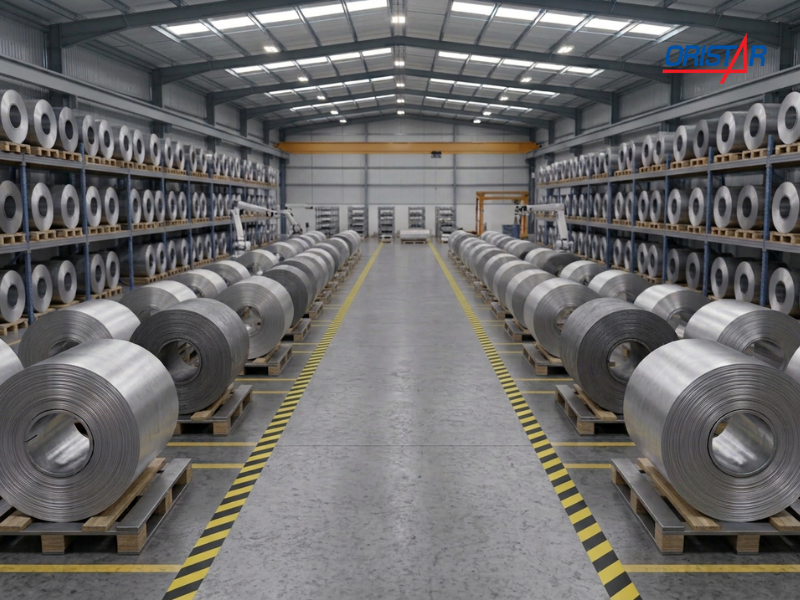
Some notable characteristics of stainless steel coils:
- Continuous strip form, large length.
- There are many options for steel grades, thicknesses and widths.
- Can be processed by methods such as slitting, cutting, stamping, bending or shaping depending on the type of material and technical requirements.
- Suitable for large volume production and continuous processing lines.
Popular types of stainless steel coils
Stainless steel coils come in many grades with differences in composition, corrosion resistance, durability and formability. Therefore, instead of choosing the common name "rolled stainless steel", businesses should determine the steel grade based on the usage environment and processing method of the product. In Oristar's stainless steel coil catalog, grades can be divided into the following typical groups:
Material group | Typical mark | Characteristics and usage needs |
Common austenitic stainless steel | SUS201, SUS304 | Suitable for many household, industrial and detailed applications that require corrosion resistance and shaping |
SUS304 stainless steel according to state and surface | SUS304 2B, SUS304 BA, SUS304 CSP, SUS304 No.1 | Same SUS304 base but different state or surface finish, suitable for different requirements for shape and appearance |
SUS316L stainless steel | SUS316L, SUS316L 2B, SUS316L BA | Good corrosion resistance, often considered for harsher working environments than SUS304 |
Stainless steel for stamping, bending and shaping | SUS301CSP | Has durability and elasticity suitable for strip details, springs or products that need shaping |
Ferritic stainless steel | SUS430, SUS430 2B | Corrosion resistance and stability make it suitable for many household, decorative and industrial applications |
Martensitic stainless steel | SUS420J2, 9RU10 | Has higher hardness and abrasion resistance, suitable for parts that require this characteristic |
Choose stainless steel coils according to processing needs
If the product requires stamping, bending or shaping, the material's ability to deform is a factor that needs to be considered along with thickness and supply condition. SUS301CSP is a notable choice in this group, while SUS304 in suitable states can also be used for a variety of shaping needs.
For products that need a beautiful, bright and uniform surface, businesses should pay attention to the surface state in addition to determining the steel grade. For example, SUS304 BA and SUS304 2B have different surface characteristics, so the choice needs to be based on the product's visual requirements.
For environments with high requirements for corrosion resistance, SUS316L is often considered instead of SUS304. However, the final choice still needs to be based on the exposure environment, temperature, chemicals and actual working conditions.
Outstanding properties of stainless steel coils
The advantages of rolled stainless steel lie not only in its resistance to corrosion. In addition, the roll form allows the supply of materials in large lengths, making it convenient to feed into continuous production and processing lines. Thanks to that, rolled steel is suitable for many production processes with high requirements for productivity and stability. These characteristics also create notable advantages of rolled steel during use.
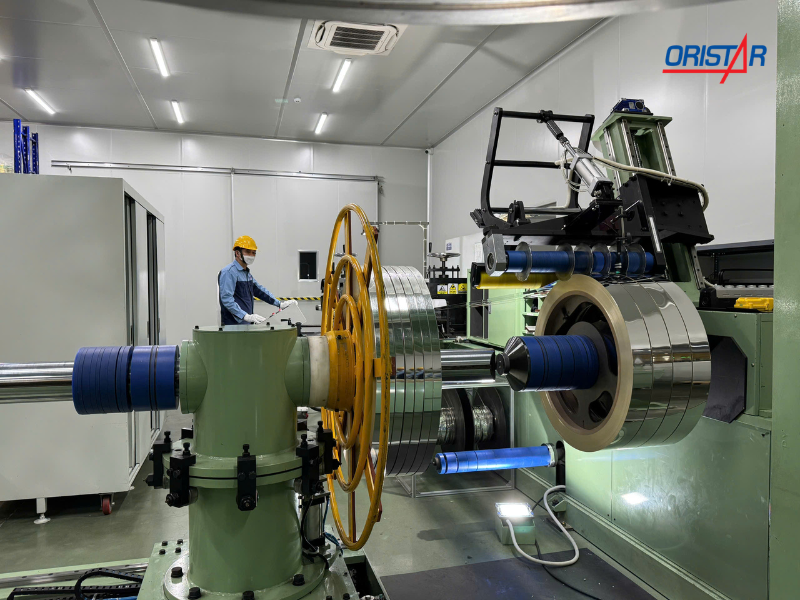
Suitable for continuous production
Steel coils provide long material ranges, suitable for lines that require continuous billet feeding. Materials can be put through operations such as stamping, cutting or shaping according to established manufacturing processes.
This is especially useful for high-volume businesses, where reducing bar changes can help maintain line stability.
Many options for grades and surface conditions
One of the points to consider when buying stainless steel coils is the variety of grades and surface conditions. For example, the same SUS304 but 2B, BA, CSP and No.1 serve different requirements. Therefore, simply recording the order as “SUS304 roll” may not be enough for the supplier to accurately determine the product to be delivered. If the product has specific surface or machinability requirements, this information should be determined at the outset.
Flexibility in processing
Depending on the grade, thickness and material condition, rolled stainless steel can be put into processes such as slitting, cutting, stamping, bending and shaping.
For stamping or bending products, formability needs to be considered along with thickness, bending radius, degree of deformation and material condition. If the material is not properly selected, the machining process may cause unexpected deformation, cracking or affect product quality.
Convenient transportation and storage
Steel coils help concentrate a large amount of material in a unit of goods, convenient for transportation and warehouse arrangement. However, storage needs to be based on roll volume, lifting equipment and storage conditions to ensure safety and limit impact on material surface quality.
Application of stainless steel coils in industrial production
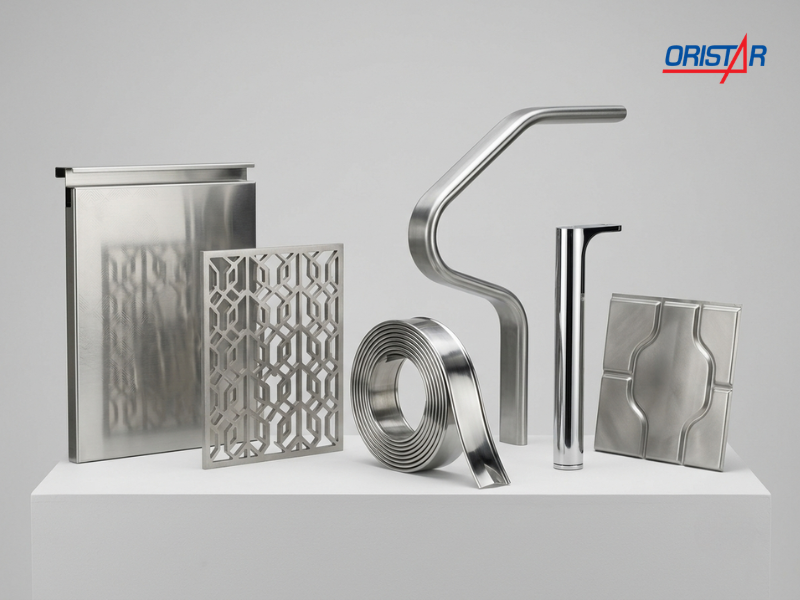
Stainless steel coils are used in many fields thanks to the variety of grades, specifications and surface conditions. Depending on the steel grade, specifications and usage requirements, stainless steel coils can be selected for many product groups and industries.
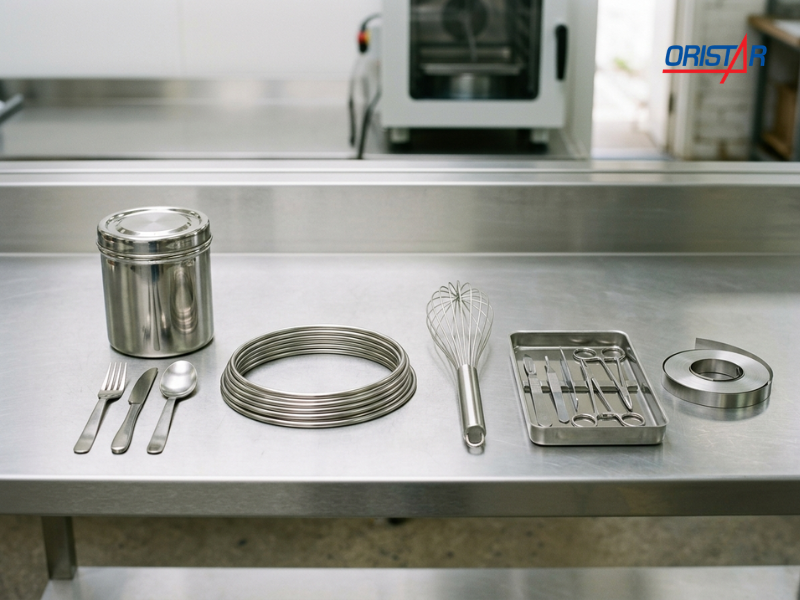
Food and medical industry
Stainless steel coils are used in products that require durability, cleanability and a surface suitable for use conditions:
- Food processing equipment:Machining parts and surfaces of equipment for processing.
- Medical tools:Used in the production of tools and equipment according to technical requirements.
- Surfaces requiring high hygiene:Suitable for products that require surfaces that are easy to clean and maintain.
Note:When choosing materials, consider the steel grade and surface condition to meet the specific requirements of each application.
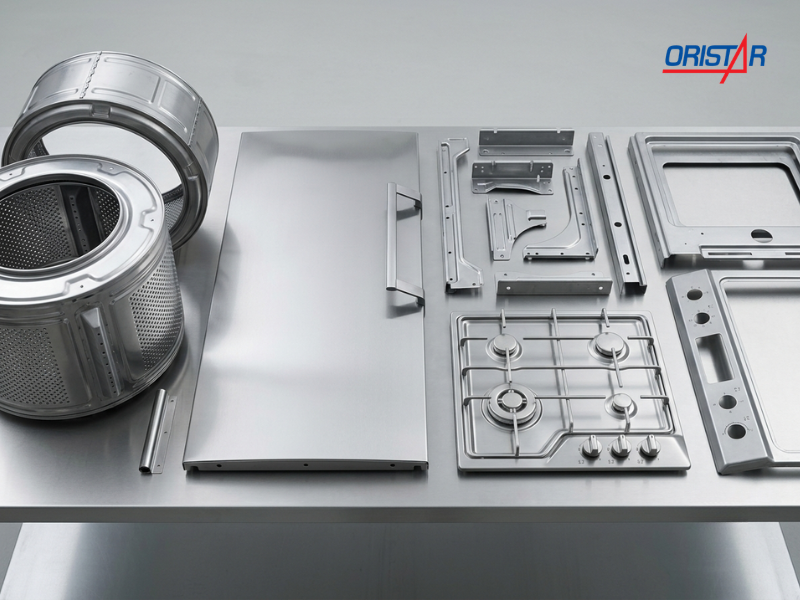
Household appliances
In the household sector, stainless steel coils are widely used thanks to their ability to meet product manufacturing and shaping processes:
- Kitchen equipment:Used for equipment parts and details.
- Fridge:Application in product parts and surfaces.
- Washing machine:Used for details in accordance with design and production requirements.
- Other household products:Steel coils can be selected according to grade, thickness and surface requirements.
Note:For details that require aesthetics, it is necessary to choose the appropriate surface condition in addition to determining the steel grade.
Decoration and construction
Stainless steel coils are used in items that require both material properties and focus on appearance:
- Architectural works:Used for details and items consistent with the design.
- Facade:Application for surfaces that require aesthetics and convenient maintenance.
- Interior details:processed into products and parts according to required specifications.
- Decorative Surface:Suitable for products that need a smooth, bright surface that is easy to clean and maintain.
Note:When choosing, you should determine the steel grade, thickness, width and surface requirements from the beginning to facilitate the processing process.
Chemical industry
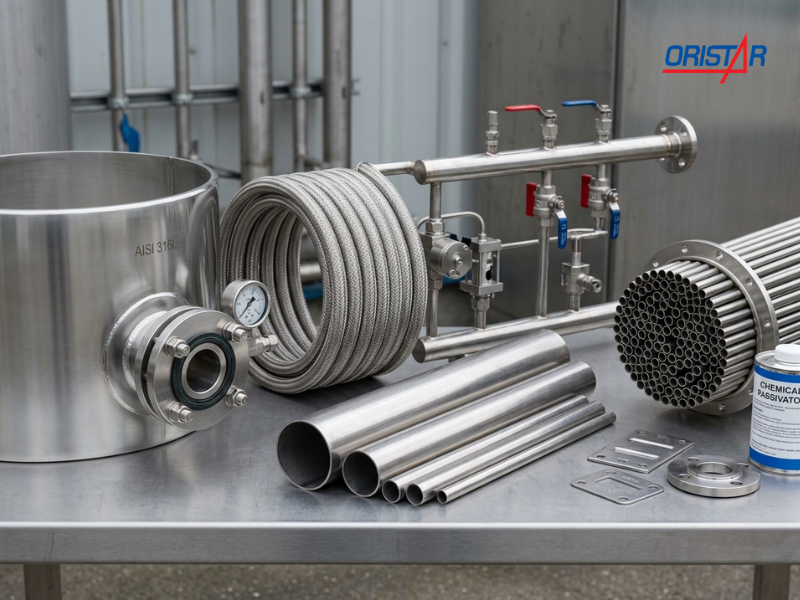
In the chemical industry, stainless steel coils are used for equipment that must work in environments with high requirements for corrosion resistance:
- Tank:Use steel types suitable for storage conditions and contact environments.
- Pipeline:Applications in chemical pipeline and processing systems.
- Chemical processing equipment:Select materials according to working conditions and specific technical requirements.
- Corrosive environments:Priority should be given to steel grades with appropriate corrosion resistance.
Note:Material selection should be based on the usage environment, chemical exposure and technical requirements, rather than just on price or roll form.
How is stainless steel coil different from stainless steel sheet?
Steel coils and steel plates differ mainly in the form of supply, material length and how the billet is put into the processing process. Coils have large lengths, suitable for continuous production lines and large-quantity processing, while steel sheets are supplied in individual panels with defined sizes. Therefore, choosing roll or sheet form should be based on the production process and requirements of the final product.
Criteria | Rolled steel | Steel plate |
Shape | The steel strip is rolled into coils | Flat plate with defined dimensions |
Material length | Large, suitable for continuous production | Limited to the size of each panel |
Machining | Suitable for slitting, stamping, cutting and shaping | Suitable for cutting, milling, and processing of individual panels |
Mass production | Fit | May be suitable depending on the process |
The ability to cut suffering | Can be cut into many sizes according to needs | Not applicable by roll slitting method |
Select | When strip material and continuous production are needed | When you need sheet workpieces with specific dimensions |
When should you choose stainless steel coils?
Steel coils are suitable when businesses:
- Large quantity production.
- Need to continuously supply materials to the line.
- Use strip products.
- There is a need to cut rolls according to size.
- Continuous stamping, cutting or shaping steps need to be performed.
When should you choose stainless steel plate?
Steel plates are more suitable when:
- Need workpiece with specified length × width dimensions.
- The product needs to be processed in panels.
- The production process does not require a continuous feed of material from a roll.
- It is necessary that the workpiece has the appropriate thickness or size for the next processing step.
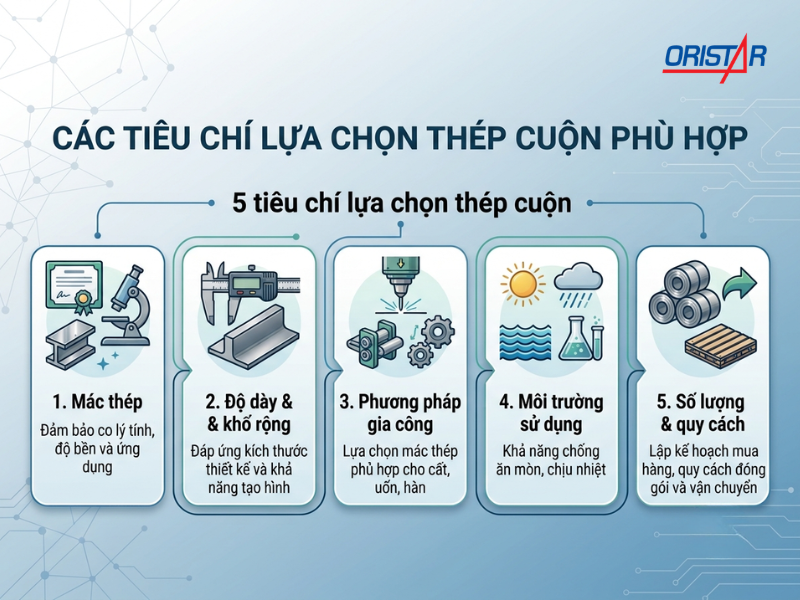
Criteria for selecting suitable steel coils
Steel grade is an important factor but not enough to determine whether a roll of material is suitable or not. An order for production needs to be determined from materials, specifications and processing methods.
- Steel grade needs to be determined according to product requirements and usage environment. If the drawing specifies SUS304, SUS316L or another specific grade, you should comply with the requirements instead of replacing yourself with a lower priced grade.
- Thickness and width must match the device and product size. If it is necessary to slit the roll, you should determine both the input roll gauge, the post-slit gauge, the number of gauges and tolerances to limit excess material.
- Surface condition is especially important for stainless steel. Statuses such as 2B, BA or No.1 create differences in appearance and ability to meet each product requirement. Therefore, surface information should be clearly stated in the order request.
- The processing method also needs to be determined in advance. A material used for deep stamping will have different requirements than a material that only needs cutting or sawing. If there is a bending process, it is necessary to consider the thickness, bending radius and degree of deformation to choose the appropriate material.
- Roll weight and specifications need to be compatible with lifting equipment, processing machines and storage capacity. With a continuous production line, roll specifications also affect roll change time and operating efficiency.
Factors affecting the price of stainless steel coils
The price of stainless steel coils is determined according to each specific grade and specification, so a general price should not be used for the entire material group. When requesting a quote, the more information a business provides, the more convenient it will be to check and determine the price.
- Steel grade:Each steel grade has different composition and material properties, so the price may vary. When requesting a quote, it is necessary to accurately determine the steel grade and applicable standards, if any.
- Thickness and width:This is important information to determine product specifications. With rolled steel that needs to be sawed, businesses should provide both the initial roll size and the finished product size after sawing for Oristar to check the ability to meet.
- Volume:Order volume affects supply options and actual prices. Therefore, when requesting a quote, you should provide the expected volume to be purchased or the number of rolls.
- Roll specifications:In addition to steel grade and size, it is necessary to determine the roll specifications suitable for the production line, such as roll weight and parameters related to the roll after processing.
- Processing:If the stainless steel coil needs to be cut to size or have other processing steps performed, the processing cost will be included in the quote. Oristar has the capacity to slit metal coils upon request, with the technical scope determined by material and order specifications.
- Quotation time:Metal material prices may change from time to time due to the influence of raw material markets, supply, exchange rates, logistics and related factors. Therefore, the reference price at one point in time should not be considered a fixed price for subsequent orders.
Oristar provides stainless steel coils for industrial production
Oristar provides rolled steel to serve a variety of industrial production and processing needs, with options for steel grades, thickness, width and roll specifications. Depending on the requirements of each order, Oristar can advise on appropriate materials and processing options before supply.
- Steel grade:Oristar provides many steel coil grades, including non-alloy steel and stainless steel groups such as S45C, SK5, SK85, SPCC, SUS201, SUS301, SUS304, SUS316L,...
- Product form:Steel coils are supplied in raw material rolls, suitable for production needs using strip materials and continuous processing lines.
- Specification:Can be selected according to thickness, width, roll weight and other technical requirements depending on the type of material.
- Cut rolls as required:Oristar has the ability to cut metal coils according to required specifications, volume and quality, suitable for orders that need to divide coils into smaller sizes for production.
- Quality control:Products are inspected according to technical requirements and applicable standards before delivery, helping businesses have a basis to compare materials with order requirements.
- Warehouse:Oristar has warehouses in Hung Yen and Ho Chi Minh City, supporting the supply of rolled steel to customers in many areas.
If your business is looking for rolled steel according to grade, thickness, width or specific specifications, please provide information about the material and usage needs for Oristar to check the ability to meet the requirements.
For orders that require slitting, cutting or processing according to specifications, customers can send technical requests to Oristar to advise on a plan suitable to actual supply and processing capabilities.
Contact information:
Khuyến cáo (Disclaimer):All technical and mechanical specifications in the article are for reference only and may change depending on specifications, material status and manufacturer. This specification is not a substitute for official production standards (JIS, ASTM...). Please contact Oristar to receive the most detailed and accurate advice for your needs.