 vi
vi
 en
en
 kr
kr
 jp
jp
 cn
cn




What is SKD61 steel plate?
SKD61 steel plate belongs to the hot working tool steel group according to JIS standards. Materials are selected for parts that must simultaneously withstand high temperatures, mechanical stress and repeated heating and cooling cycles.
Unlike cold mold steel grades such as SKD11, K110 or K340, SKD61 was developed for working environments with high temperatures.
In mold manufacturing, sheet form is often understood as:
- Thick steel plate.
- Rectangular blank.
- Panels cut according to drawings.
- The milled workpiece is close to finished size.
The plate form is suitable for parts with large cross-sections such as mold plates, mold cores, inserts, extrusion dies and heat-loaded parts.
SKD61 is often placed next to marks such as AISI H13, DIN 1.2344 or W302. However, businesses should not consider these labels as completely the same.
Replacement should be based on:
- Material standards.
- Manufacturer.
- Chemical composition.
- Supply status.
- Heat treatment process.
- Request acceptance.
Why is SKD61 suitable for making molds at high temperatures?
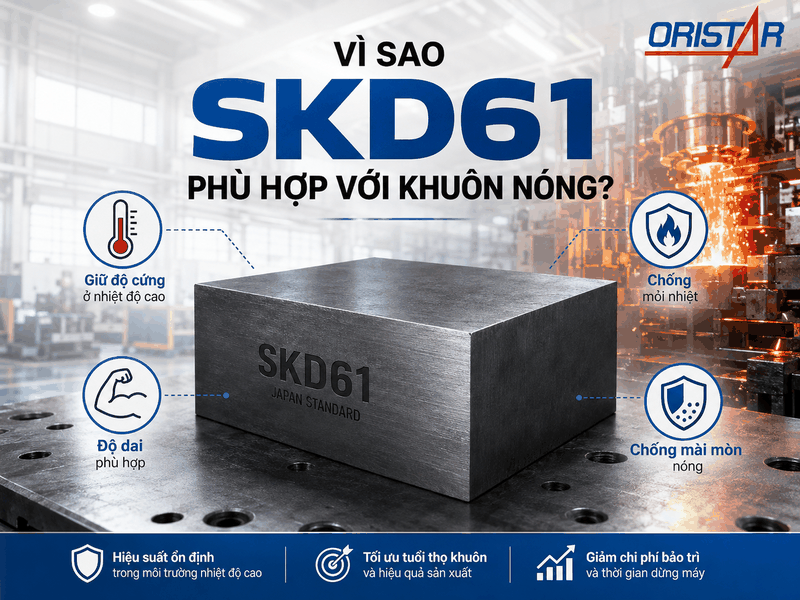
Hot-worked molds are subject to multiple damage mechanisms at the same time. The mold surface continuously receives heat, transfers heat, is subjected to pressure and is exposed to hot material during each production cycle.
SKD61 is widely used because of its ability to maintain relatively stable mechanical properties under these conditions.
Ability to retain hardness at high temperatures
In pressure casting, forging or extrusion dies, the work surface may come into contact with hot metal or the heated workpiece.
If the steel loses hardness rapidly as the temperature increases, the mold surface is susceptible to deformation, wear, or loss of accuracy.
SKD61 has the ability to retain good hot hardness, helping to maintain the shape of mold parts during operation.
This characteristic is especially important for:
- Aluminum casting mold.
- Zinc die casting mold.
- Extrusion mill.
- Hot forging mold.
- Shaping punch at high temperature.
Heat fatigue resistance
Thermal fatigue forms because the mold surface continuously heats up and cools down.
Each thermal cycle creates expansion and contraction stresses. After a long time, small mesh cracks may appear on the surface, often called crow's feet.
SKD61 has good thermal fatigue resistance when selected, processed and heat treated properly.
However, the actual lifespan depends on:
- Molten metal temperature.
- Cycle speed.
- Cooling system.
- Lubricant.
- Water line design.
- Hardness after heat treatment.
Toughness suitable for mechanical load
The hot mold is not only resistant to heat but also to compression, impact and variable loads.
If the material is too brittle, the mold may develop cracks at small corners, cross-section changes or stress concentration areas.
SKD61 has suitable toughness for many hot mold parts, helping to reduce the risk of cracking in complex working conditions.
Resistant to hot abrasion
During casting, forging or extrusion, the die surface is subjected to friction with the material at high temperatures.
This phenomenon can cause:
- Surface wear.
- Erosion.
- Flaking.
- Loss of size.
- Reduces product smoothness.
SKD61 assists in maintaining a more stable work surface under hot abrasive conditions.
Specification of SKD61 steel plate
Sheet steel SKD61 specifications need to be selected based on finished product size, machining allowance, mold shape and heat treatment requirements.
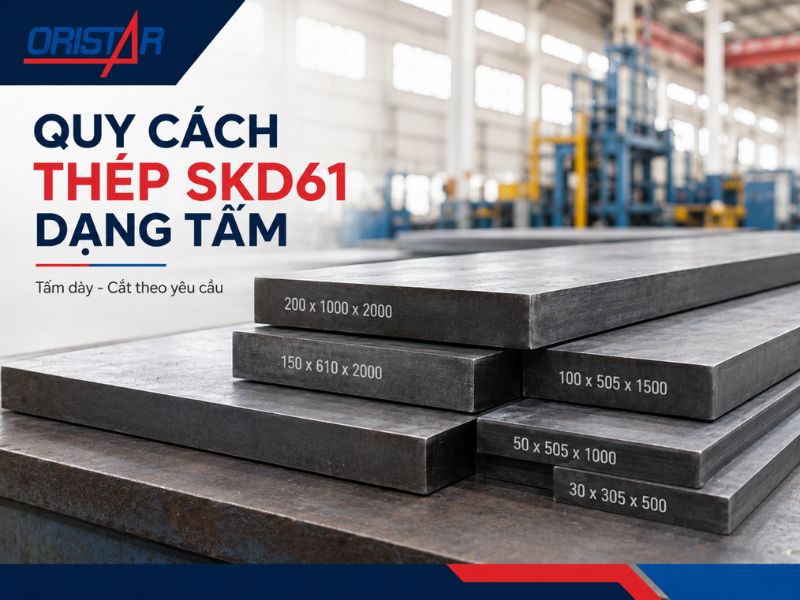
Actual parameters must be compared against inventory and documents of each shipment.
Category | Information |
Steel grade | SKD61 |
Material group | Hot working tool steel |
Supply format | Thick plate, rectangular billet |
Status | According to actual shipment |
Thickness | According to inventory or request |
Width | According to inventory or cutting plan |
Length | According to inventory or drawing |
Machining | Cutting, milling, heat treatment |
Document | According to product and shipment |
How to choose plate thickness
The thickness of the blank should not be exactly equal to the thickness of the finished product.
Enterprises need to calculate additional balance for:
- Milling to create standard faces.
- Finished grinding.
- Correct deformation after heat treatment.
- Flatness control.
- Parallelism control.
If the workpiece is too close to the final dimension, the part may not have enough material to repair after heat treatment.
On the contrary, too large an embryo increases:
- Purchase volume.
- Material costs.
- Milling time.
- Tool wear and tear.
- Production time.
Whole slabs and cut blanks
Buying raw sheets is suitable when a business needs to produce many parts or wants to proactively divide billets at the factory.
Cutting blanks are suitable when:
- The amount of detail is not large.
- Determined size.
- Businesses want to reduce losses.
- Need to shorten preparation time.
- There is no suitable cutting equipment.
Choosing between stock and cut stock should be based on total cost, not just the unit price of the material.
Application of SKD61 steel plate
The SKD61 plate form is convenient for processing mold parts with large cross-sections, large working surfaces or requiring high stability.
Each application has different loading and heat mechanisms, so it is necessary to choose the appropriate workpiece and heat treatment regime.
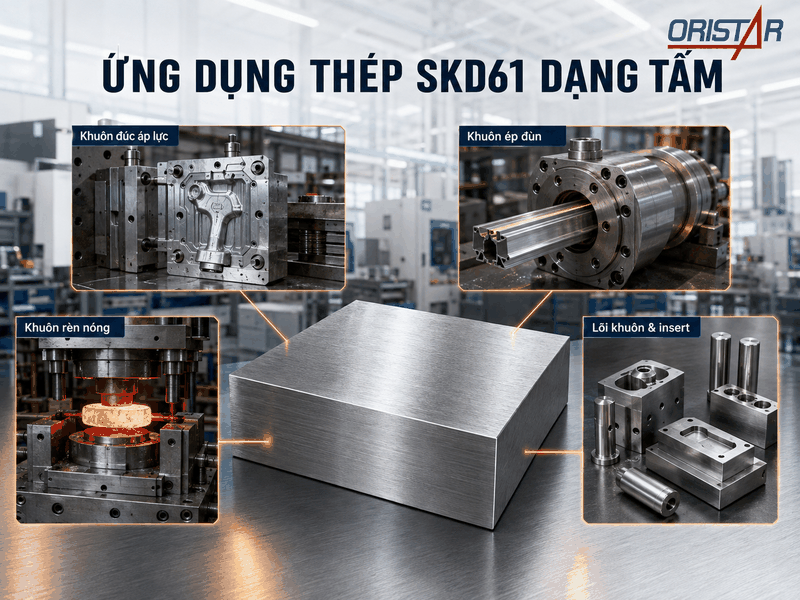
Pressure die casting
Pressure die casting molds must be in constant contact with molten metal and subjected to high pressure for short periods of time.
SKD61 is commonly used for:
- Mold core.
- Insert mold.
- Mold plate.
- Push pin.
- Metal conductive details.
- Parts subject to direct heat.
The material is suitable for die casting of aluminum, zinc and some non-ferrous alloys when the process is properly designed.
Extrusion mold
The extrusion mold is subjected to high temperature, pressure and friction at the same time.
SKD61 sheet form can be processed into:
- Presser.
- Support plate.
- Insert.
- Pressing pestle.
- Shaping part.
Its toughness and ability to retain mechanical properties help the material withstand continuous pressing cycles.
Forging and hot stamping molds
In hot forging, the die is subjected to strong impacts and high temperatures from the workpiece.
SKD61 is suitable for:
- Forging mold.
- Forging pestle.
- Hot stamping die.
- Insert plate.
- Shaping tools.
Too high a hardness can increase the risk of cracking. Therefore, heat treatment needs to balance wear resistance and toughness.
Mold core and insert
Mold cores and inserts often have complex shapes, are subjected to concentrated loads and are in direct contact with high heat areas.
Plate-shaped SKD61 blanks help engineers proactively:
- Arrange machining direction.
- Residual control.
- Create standard surface.
- Prepare for heat treatment.
- Finished grinding after heat treatment.
Hot cutting knives and heat-resistant tools
SKD61 can be used for some hot cutting knives or high temperature material cutting tools.
The material should not be considered the default choice for cold cutters. For working conditions at normal temperatures, cold mold steel lines may be more suitable.
Compare SKD61 and SKD11 steel
SKD61 and SKD11 are both tool steels, but serve two different working environments. Choosing the wrong steel group can reduce mold life even though the material has high hardness.
Criteria | SKD61 | SKD11 |
Working group | Hot working steel | Cold worked steel |
Heat resistance | Good | Not the main priority |
Heat fatigue resistance | Fit | More limited |
Toughness | Phù hợp với tải nhiệt và cơ học | Suitable for stamping and cold cutting |
Cold abrasion resistant | Not the only advantage | Good |
Application | Pressure casting, forging, extrusion | Cold stamping, cutting knife, mortar and pestle |
SKD61 nên được lựa chọn khi chi tiết:
- Contact with hot metal.
- Resistant to hot-cooling cycles.
- Cần chống mỏi nhiệt.
- Work at high temperatures.
- Chịu tải cơ học kết hợp tải nhiệt.
SKD11 phù hợp hơn khi chi tiết:
- Works mainly at normal temperature.
- Cần chống mài mòn cao.
- Dùng cho dập nguội.
- Dùng làm dao cắt.
- Dùng làm chày và cối nguội.
Không nên thay SKD11 bằng SKD61 hoặc ngược lại chỉ dựa trên độ cứng.
Các lỗi hư hỏng thường gặp ở khuôn SKD61
SKD61 có khả năng chịu nhiệt tốt nhưng không thể loại bỏ hoàn toàn mọi dạng hư hỏng. Thiết kế khuôn, gia công, nhiệt luyện và vận hành đều ảnh hưởng đến tuổi thọ.
Nhận diện đúng cơ chế hỏng giúp doanh nghiệp điều chỉnh vật liệu và quy trình phù hợp.
Nứt chân chim do mỏi nhiệt
Nứt chân chim thường xuất hiện thành mạng lưới nhỏ trên bề mặt khuôn.
Nguyên nhân phổ biến gồm:
- Chu kỳ nhiệt quá nhanh.
- Làm mát không đều.
- Nhiệt độ bề mặt quá cao.
- Chất bôi trơn không phù hợp.
- Bề mặt khuôn có ứng suất dư.
- Độ cứng không phù hợp.
Các vết nứt nhỏ có thể phát triển và ảnh hưởng đến chất lượng sản phẩm.
Nứt vỡ do tập trung ứng suất
Góc sắc, lỗ nhỏ hoặc thay đổi tiết diện đột ngột có thể tạo vùng tập trung ứng suất.
Khi kết hợp với nhiệt độ và tải trọng, những vị trí này dễ phát sinh nứt.
Thiết kế nên ưu tiên:
- Bán kính chuyển tiếp phù hợp.
- Tiết diện cân đối.
- Đường nước hợp lý.
- Gia công bề mặt ổn định.
- Nhiệt luyện đồng đều.
Mòn và xói bề mặt khuôn
Dòng kim loại nóng chảy có tốc độ cao có thể gây xói mòn tại cửa phun hoặc vùng dòng chảy va đập trực tiếp.
Mài mòn cũng xảy ra trong quá trình ép đùn, rèn và tạo hình.
Các biện pháp kiểm soát gồm:
- Điều chỉnh thiết kế dòng chảy.
- Kiểm soát nhiệt độ.
- Tối ưu bề mặt.
- Xử lý bề mặt khi phù hợp.
- Bảo trì định kỳ.
Mềm bề mặt
Nếu nhiệt độ làm việc vượt quá giới hạn phù hợp trong thời gian dài, bề mặt có thể bị giảm độ cứng.
Hệ quả gồm:
- Mòn nhanh.
- Biến dạng.
- Mất độ chính xác.
- Tăng bám dính vật liệu.
Doanh nghiệp cần kiểm soát nhiệt độ khuôn và thời gian tiếp xúc nhiệt.
Gia công và nhiệt luyện thép SKD61 dạng tấm
SKD61 chỉ phát huy đầy đủ hiệu quả khi được gia công và nhiệt luyện theo quy trình phù hợp. Sai lệch ở công đoạn chuẩn bị phôi có thể làm tăng biến dạng hoặc giảm tuổi thọ khuôn.
ORISTAR hỗ trợ cắt, phay và nhiệt luyện theo yêu cầu kỹ thuật.
Cắt tấm theo kích thước
ORISTAR nhận cắt tấm và thanh thép theo kích thước yêu cầu.
Phạm vi kỹ thuật tham khảo đối với sản phẩm thép sau gia công:
- Chiều dày: 5–600 mm.
- Chiều rộng: 15–1.270 mm.
- Chiều dài: 12–6.000 mm.
Khả năng thực hiện cụ thể phụ thuộc vào:
- Quy cách phôi ban đầu.
- Hình dạng sản phẩm.
- Mác thép.
- Dung sai.
- Số lượng.
- Tình trạng thiết bị.
Phay bề mặt
Phay giúp tạo mặt chuẩn và đưa phôi về gần kích thước yêu cầu.
Khách hàng nên cung cấp:
- Kích thước sau phay.
- Số mặt cần phay.
- Độ phẳng.
- Độ song song.
- Dung sai.
- Lượng dư cho mài.
Với khuôn lớn, gia công cân đối các mặt giúp hạn chế ứng suất không đều.
Nhiệt luyện
Quy trình nhiệt luyện SKD61 thường gồm:
- Gia công thô.
- Khử ứng suất khi cần.
- Gia nhiệt sơ bộ.
- Tôi theo quy trình phù hợp.
- Ram đủ số lần.
- Kiểm tra độ cứng.
- Kiểm tra biến dạng.
- Gia công hoàn thiện.
Không nên áp dụng một chế độ nhiệt luyện giống nhau cho mọi chi tiết.
Kích thước, hình dạng, độ cứng mục tiêu và điều kiện làm việc cần được xem xét đồng thời.
Mua thép SKD61 dạng tấm tại ORISTAR
ORISTAR cung cấp thép dụng cụ cho ngành khuôn mẫu chính xác, cơ khí và sản xuất công nghiệp. Phương án cung ứng được xây dựng theo quy cách, tồn kho và yêu cầu gia công thực tế.
Khách hàng có thể tiếp cận các lợi thế:
- Kho tại Hưng Yên và TP.HCM.
- Hỗ trợ kiểm tra quy cách và tồn kho.
- Có thể bán lẻ từ một tấm nếu hàng có sẵn.
- Nhận cắt theo kích thước.
- Hỗ trợ phay bề mặt.
- Cung cấp dịch vụ nhiệt luyện.
- Miễn phí vận chuyển cho đơn hàng từ 300 kg.
- Cung cấp thông tin theo chứng từ từng lô.
- Hỗ trợ chuẩn bị phôi theo bản vẽ.
ORISTAR không cung cấp dịch vụ CNC trọn gói, cắt laser hoặc cắt plasma cho sản phẩm này.
Kết luận
Thép SKD61 dạng tấm là vật liệu phù hợp cho khuôn đúc áp lực, khuôn ép đùn, khuôn rèn và các chi tiết phải chịu nhiệt độ cao.
Hiệu quả của vật liệu phụ thuộc vào việc chọn đúng phôi, thiết kế khuôn, quy trình gia công và chế độ nhiệt luyện.
Doanh nghiệp cần xác định rõ kích thước thành phẩm, lượng dư và cơ chế hư hỏng trước khi đặt vật liệu.
Thông tin liên hệ:
- Hotline: 098 875 06 86
- Email: info@oristar.vn
- Zalo OA
- Website E-commerce
- Official Website
Khuyến cáo (Disclaimer): Mọi thông số kỹ thuật và cơ lý tính trong bài viết chỉ mang tính chất tham khảo và có thể thay đổi tùy thuộc vào quy cách, trạng thái vật liệu và nhà sản xuất. Thông số này không thay thế cho các tiêu chuẩn sản xuất chính thức (JIS, ASTM...). Quý khách vui lòng liên hệ Oristar để nhận tư vấn chi tiết và chính xác nhất cho nhu cầu của mình.