 vi
vi
 en
en
 kr
kr
 jp
jp
 cn
cn




What is S50C Steel Plate?
S50C steel plate is a medium carbon steel supplied as thick plate or sheet billet. The material is often used to make parts that do not require extreme heat resistance or wear resistance.
S50C is a steel grade according to Japanese JIS standards. The letter “S” represents the steel used for the machine structure, while the number “50” represents a nominal carbon content of about 0.50%.
With a higher carbon content than S45C steel, S50C is capable of achieving higher hardness and durability after heat treatment. In turn, toughness, weldability and machining stability may be lower.
S50C steel plates are often used for:
- Mold base.
- Mold holding plate.
- Support plate.
- Machine plate.
- Machine table.
- Gears.
- Axis.
- Latch.
- Mechanical parts subject to average loads.
In the mold industry, S50C often serves as a structural or substrate material. This steel grade is not suitable for replacing tool steel in locations subject to constant wear, impact or high temperatures.
Equivalent Steel Standards and Grades S50C
Comparing equivalent marks helps businesses check materials on drawings and choose the appropriate supply source. However, equivalent marks are for reference only and should not be replaced directly without checking the standards.
Some steel grades that are often compared to S50C include:
Standard | Reference steel grade |
JIS Japan | S50C |
AISI/SAE USA | 1050 |
DIN/EN Europe | C50, C50E |
GB China | 50 |
ISO | C50 |
The above labels have relatively close carbon content and application ranges. However, manganese, silicon, sulfur, phosphorus limits and mechanical property requirements may vary.
When replacing materials, businesses should check:
- Standards stated on drawings.
- Chemical composition according to certificate.
- Supply status.
- Initial hardness.
- Requires heat treatment.
- Plate size and thickness.
- Working conditions of details.
For important details, replacement of steel grade needs to be confirmed by the design engineer or technical department.
Chemical Composition of S50C Steel
Chemical composition directly affects the hardness, durability, machinability and reaction of steel during heat treatment.
Reference composition table of S50C steel:
Element | Reference content (%) | Technical influence |
Carbon – C | 0.47–0.53 | Increases hardness, durability and abrasion resistance |
Silicon – Si | 0.15–0.35 | Increases durability and supports deoxidation |
Manganese – Mn | 0.60–0.90 | Increases durability, hardness and quenching ability |
Phosphorus – P | Maximum about 0.03 | Impurities need to be controlled to limit brittleness |
Sulfur – S | Maximum about 0.035 | Affects toughness and machinability |
Carbon content of about 0.50% helps S50C have higher hardness than low carbon steels. This is the basis for the materials used for machine parts, mold bases and load-bearing parts.
However, high carbon also reduces weldability. If S50C welding is required, businesses must control the preheating temperature, welding material and cooling process to limit cracking.
The actual composition should be confirmed by the certificate of each batch of material. The reference composition table should not be used as a substitute for CO/CQ or material test results.
Characteristics of S50C Steel Plate
S50C was selected due to the balance between durability, hardness, machinability and cost. However, effective use also depends on the material state and heat treatment process.
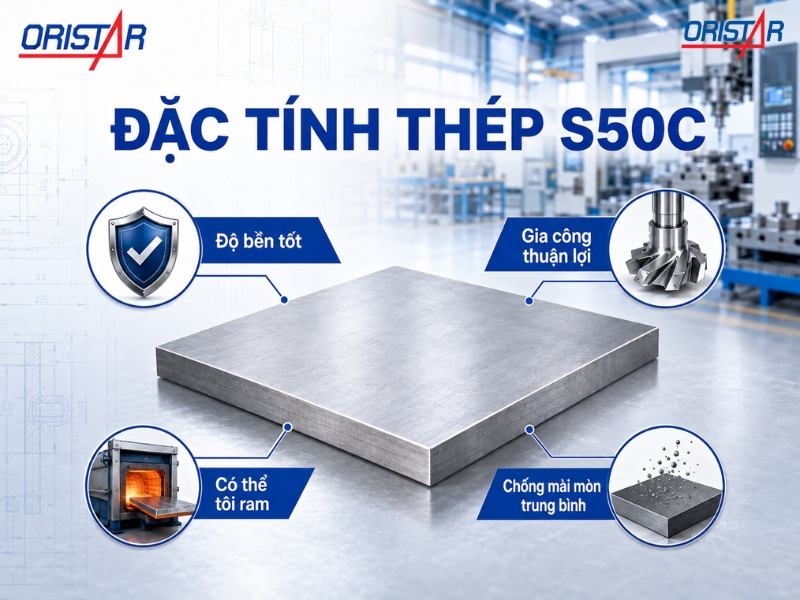
Relatively good durability and hardness
S50C has a high average carbon content so it has better strength and hardness than S45C under equivalent conditions.
In the rolled, normalized or tempered state, the hardness of the material will be different. Therefore, it is not possible to apply a single hardness value to every S50C panel.
This feature is suitable for:
- Mold support plate.
- Machine details.
- Axis.
- Gears.
- Load-bearing pin.
- Structural panels have high durability requirements.
Suitable machining capabilities
S50C can be cut, turned, milled, drilled and ground using conventional mechanical equipment. Machinability depends on the hardness and heat treatment state of the material.
In the unquenched state, S50C has relatively favorable machinability. After tempering, the hardness increases, causing the cutting speed, knife type and cooling mode to be adjusted.
When processing large panels, businesses need to pay attention to:
- Residual stress in materials.
- Double-sided milling sequence.
- Processing surplus.
- The possibility of warping when peeling off material unevenly.
- Requires stress relief before finishing.
Heat treatment ability
S50C can be quenched and tempered to increase hardness, durability and abrasion resistance. This is an advantage compared to low carbon steels.
However, S50C has a more limited hardenability than alloy steel. With thick panels, the surface and core hardness can differ significantly.
Actual heat treatment capacity depends on:
- Plate thickness.
- Detailed dimensions.
- My temperature.
- Cooling environment.
- Ram temperature.
- Heat retention time.
- Product shape.
Abrasion resistance is average
After heat treatment, S50C has better abrasion resistance than its original state. However, the material still cannot replace tool steel in places of high friction or continuous work.
For highly wear-resistant parts, businesses should consider grades such as K110, K340 or more suitable tool steels.
Limited welding ability
The relatively high carbon content makes S50C more difficult to weld than S45C and low carbon steels.
Uncontrolled welding can cause:
- Cracking in heat affected zone.
- Increase local stiffness.
- Deformation.
- Reduced toughness.
- Residual stress appears.
If the part requires a lot of welding or the structure is complex, S50C may not be the optimal choice.
Specification of S50C Steel Plate
S50C steel plate specifications depend on the manufacturer, rolling method, import source and inventory status. Customers need to confirm the actual size before ordering.
Parameters that need to be checked include:
- Plate thickness.
- Width.
- Length.
- Thickness tolerance.
- Flatness.
- Surface condition.
- Rolling or heat-treated state.
- Weight of each plate.
S50C steel is often supplied in thick plates to serve the mold and machine manufacturing industry. Sheets can be cut into small blanks according to drawings or machined dimensions.
Some common surface types:
- Hot rolled surface.
- Cleaned surface.
- The plate has been rough milled.
- The milled workpiece is prepared for size.
- The plate has been ground according to individual requirements.
When buying S50C steel plate, you should not only pay attention to the nominal size. Tolerance and surface condition directly affect the machining allowance.
Heat Treatment S50C Steel Plate
Heat treatment helps improve the mechanical properties of S50C but at the same time increases the risk of warping and cracking if the process is not suitable.
A heat treatment process may include:
- Preheat as needed.
- Heat to suitable tempering temperature.
- Retains heat according to the thickness of the part.
- Cool in a suitable environment.
- Ram to reduce stress and adjust stiffness.
- Check for hardness, flatness and deformation.
For thick plates, the penetration ability of S50C needs to be carefully evaluated. The surface can achieve high hardness while the core is lower.
Common risks include:
- Curved panels.
- Cracked edges.
- Cracked at sharp corner.
- Hardness difference.
- Surface oxidation.
- Carbon escape.
- Deformation after cooling.
To limit risks, parts should be designed with reasonable transition angles, avoid sudden cross-section changes and control residuals after heat treatment.
With large panels, businesses should consider stress relief after rough machining before finishing milling.
Application of S50C Steel Plate
S50C is used in molds and machine manufacturing thanks to its reasonable cost, good durability and relatively convenient machinability.
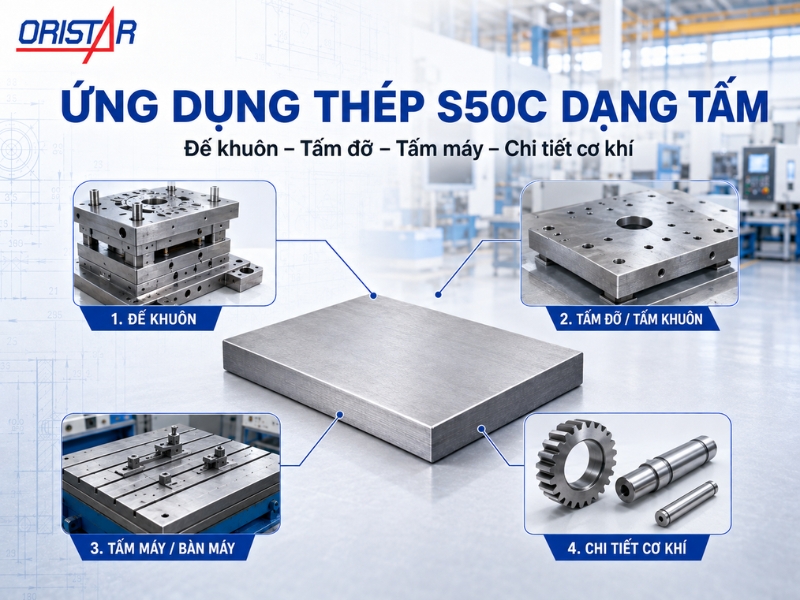
Mold base and support plate
S50C thường được dùng làm đế khuôn, tấm đỡ và tấm giữ trong các bộ khuôn có tải trọng trung bình.
The material is suitable because it has higher hardness than conventional structural steel and lower cost than tool steel.
However, in locations that come into direct contact with products or are subject to high friction, businesses should use appropriate tool steel.
Regular mold plate
S50C có thể dùng cho các loại khuôn đơn giản, sản lượng không quá lớn hoặc yêu cầu bề mặt không quá khắt khe.
Vật liệu phù hợp với:
- Khuôn nhựa thông dụng.
- Khuôn ép sản lượng vừa.
- Tấm khuôn phụ trợ.
- Khuôn thử nghiệm.
- Bộ phận không trực tiếp chịu mài mòn cao.
S50C không phải lựa chọn tối ưu cho lòng khuôn yêu cầu độ bóng cao, chống ăn mòn hoặc tuổi thọ đặc biệt lớn.
Tấm máy và bàn máy
Độ bền và khả năng gia công của S50C phù hợp với tấm máy, bàn gá, tấm đỡ và kết cấu chịu lực.
Với tấm lớn, quá trình phay cần được thực hiện cân đối hai mặt để hạn chế cong vênh do giải phóng ứng suất.
Bánh răng và chi tiết truyền động
S50C có thể được sử dụng để chế tạo bánh răng, đĩa xích và một số chi tiết truyền động sau nhiệt luyện.
Khả năng ứng dụng phụ thuộc vào:
- Tải trọng.
- Tốc độ quay.
- Điều kiện bôi trơn.
- Độ cứng yêu cầu.
- Tuổi thọ thiết kế.
Với chi tiết chịu tải nặng hoặc yêu cầu độ bền mỏi cao, thép hợp kim có thể phù hợp hơn.
Trục, chốt và chi tiết máy
S50C được dùng cho trục, chốt, mặt bích và các chi tiết chịu tải cơ học trung bình.
Sau tôi ram, vật liệu có thể đạt sự cân bằng giữa độ cứng và độ bền. Tuy nhiên, kích thước chi tiết phải phù hợp với khả năng tôi thấu của thép carbon.
So Sánh Thép S50C Và S45C Dạng Tấm
S50C và S45C đều là thép carbon trung bình, thường được sử dụng trong cơ khí và khuôn mẫu. Khác biệt chính nằm ở hàm lượng carbon và khả năng đạt độ cứng.
Tiêu chí | S50C | S45C |
Hàm lượng carbon | Cao hơn | Thấp hơn |
Độ cứng sau nhiệt luyện | Thường cao hơn | Thấp hơn S50C |
Độ bền | Cao | Khá |
Độ dai | Thấp hơn S45C | Tốt hơn |
Khả năng gia công | Khá | Dễ hơn |
Khả năng hàn | Hạn chế | Tốt hơn S50C |
Khả năng chống mài mòn | Tốt hơn | Thấp hơn |
Ứng dụng | Đế khuôn, tấm máy, chi tiết chịu tải | Trục, chi tiết máy, kết cấu cơ khí |
Chi phí | Tương đương hoặc nhỉnh hơn | Thường dễ tiếp cận |
S50C phù hợp khi cần tăng độ cứng và khả năng chống mài mòn. S45C phù hợp hơn khi ưu tiên độ dai, khả năng gia công và giảm rủi ro nứt.
Không nên chọn S50C chỉ vì có hàm lượng carbon cao hơn. Vật liệu cần được đánh giá theo điều kiện tải, hình dạng chi tiết và phương pháp nhiệt luyện.
Lưu Ý Khi Mua Thép S50C Dạng Tấm
Kiểm tra vật liệu trước khi gia công giúp hạn chế sai mác, thiếu kích thước và phát sinh chi phí trong quá trình sản xuất.
Kiểm tra nguồn gốc và chứng chỉ
CO/CQ giúp xác nhận:
- Mác thép.
- Tiêu chuẩn sản xuất.
- Thành phần hóa học.
- Số lô.
- Nhà sản xuất.
- Trạng thái cung cấp.
Với chi tiết quan trọng, doanh nghiệp có thể kiểm tra bổ sung thành phần hoặc độ cứng đầu vào.
Xác nhận dung sai chiều dày
Hai tấm có cùng chiều dày danh nghĩa nhưng có thể khác về dung sai. Nếu phôi gần sát kích thước hoàn thiện, dung sai âm có thể làm thiếu lượng dư.
Kiểm tra bề mặt
Bề mặt cần được kiểm tra các dấu hiệu:
- Rỗ.
- Nứt.
- Lõm.
- Gỉ sâu.
- Bong vảy cán.
- Xước lớn.
- Khuyết tật cạnh.
Khuyết tật bề mặt có thể làm tăng lượng gia công hoặc khiến phôi không đạt kích thước sau phay.
Xác nhận trạng thái vật liệu
S50C có thể được giao ở trạng thái cán nóng, thường hóa hoặc đã qua xử lý khác. Trạng thái khác nhau ảnh hưởng đến độ cứng và khả năng gia công.
Không chọn chỉ theo giá thấp
Giá vật liệu thấp nhưng dung sai lớn, độ phẳng kém hoặc thiếu chứng chỉ có thể làm tăng chi phí gia công.
Với tấm đế khuôn hoặc tấm máy kích thước lớn, độ phẳng và tính ổn định có thể quan trọng hơn chênh lệch nhỏ về giá mỗi kilôgam.
Giải Pháp Cung Cấp Thép S50C Dạng Tấm Tại ORISTAR
ORISTAR cung cấp vật liệu phục vụ khuôn mẫu chính xác, chế tạo máy và các ngành sản xuất công nghiệp. Thép S50C là một trong những mác bán chạy thuộc nhóm thép carbon dùng cho chi tiết máy và kết cấu khuôn.
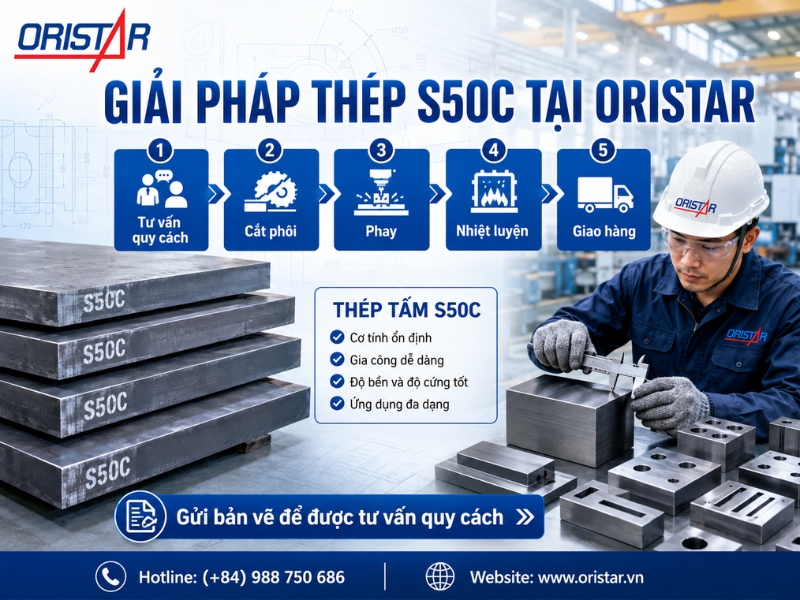
ORISTAR hỗ trợ khách hàng lựa chọn thép S50C theo:
- Bản vẽ chi tiết.
- Kích thước phôi.
- Lượng dư gia công.
- Điều kiện chịu tải.
- Yêu cầu nhiệt luyện.
- Số lượng sản xuất.
Năng lực hỗ trợ gồm:
- Cắt vật liệu theo kích thước yêu cầu.
- Phay chuẩn bị phôi.
- Nhiệt luyện theo yêu cầu kỹ thuật.
- Cung cấp chứng từ nguồn gốc theo lô.
- Tư vấn lựa chọn quy cách phù hợp.
- Giao hàng từ kho Hưng Yên và TP.HCM.
Với hàng có sẵn, ORISTAR hỗ trợ bán lẻ theo từng tấm hoặc phôi cắt. Đơn hàng từ 300 kg được áp dụng chính sách miễn phí vận chuyển theo điều kiện của ORISTAR.
Ngoài S50C, ORISTAR còn cung cấp các mác thép phục vụ khuôn mẫu và cơ khí như S45C, K110, K340 và SKD61. Việc lựa chọn mác thép cần căn cứ vào mức độ chịu tải, mài mòn, nhiệt độ và tuổi thọ yêu cầu.
Kết Luận
Thép S50C dạng tấm phù hợp với đế khuôn, tấm đỡ, tấm máy và nhiều chi tiết cơ khí chịu tải trung bình. Vật liệu có độ bền, độ cứng và khả năng nhiệt luyện tốt hơn thép carbon thấp, đồng thời có chi phí thấp hơn thép công cụ hợp kim.
ORISTAR cung cấp thép S50C dạng tấm, hỗ trợ cắt, phay và nhiệt luyện theo yêu cầu. Khách hàng có thể gửi bản vẽ hoặc quy cách cần mua để được tư vấn phương án vật liệu phù hợp.
Thông tin liên hệ:
- Hotline: 098 875 06 86
- Email: info@oristar.vn
- Zalo OA
- Website E-commerce
- Official Website
Khuyến cáo (Disclaimer): Mọi thông số kỹ thuật và cơ lý tính trong bài viết chỉ mang tính chất tham khảo và có thể thay đổi tùy thuộc vào quy cách, trạng thái vật liệu và nhà sản xuất. Thông số này không thay thế cho các tiêu chuẩn sản xuất chính thức (JIS, ASTM...). Quý khách vui lòng liên hệ Oristar để nhận tư vấn chi tiết và chính xác nhất cho nhu cầu của mình.