 vi
vi
 en
en
 kr
kr
 jp
jp
 cn
cn




Aluminum is an important material in the automotive industry thanks to its light weight, high strength and good corrosion resistance. From gasoline cars to electric vehicles, aluminum is widely used in many components to help improve performance and optimize production costs.
What is Aluminum in the Automotive Industry?
In the context of the automotive industry continuously innovating to meet performance, energy saving and emission reduction requirements, aluminum is becoming one of the top preferred materials. The proportion of aluminum per vehicle is increasing, especially in electric vehicles and new generation vehicles.
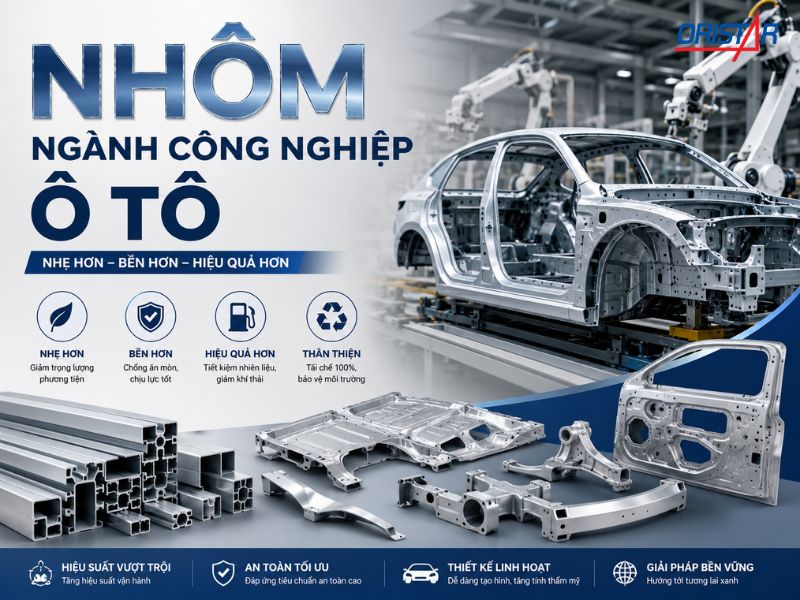
Aluminum in the automotive industry is aluminum and aluminum alloys used to make components, assemblies, chassis structures, transmission systems and many other technical parts. Thanks to its light weight but still good mechanical durability, aluminum helps manufacturers meet increasingly high requirements for performance, safety and environmental standards.
Currently, aluminum is considered a strategic material in the development of fuel-efficient vehicles, hybrid vehicles and electric vehicles.
Why does the Automobile Industry increasingly prioritize the use of aluminum?
Using aluminum not only helps reduce vehicle weight but also brings many technical, economic and environmental benefits. This is the reason why more and more car manufacturers around the world are switching from traditional materials to aluminum alloys.
Effectively Reduce Vehicle Weight
Compared to conventional steel, aluminum has a significantly lower density. This helps reduce the total vehicle weight while still maintaining the necessary stiffness and durability.
Reducing weight brings many benefits:
- Save fuel
- Reduce greenhouse gas emissions
- Increase acceleration
- Improve operating performance
- Extend the operating range of electric vehicles
Good Corrosion Resistance
Aluminum has the ability to form a natural oxide layer on the surface, helping to limit oxidation and corrosion.
This is an important advantage for:
- Vehicles operate in wet environments
- The vehicle operates in coastal areas
- Parts are frequently exposed to harsh weather conditions
High Machinability
Aluminum is suitable for many production methods:
- Stamping and shaping
- Extrusion
- CNC machining
- Welding and assembly
- Pressure casting
This helps auto parts manufacturing businesses easily meet complex technical requirements.
Recycling and Sustainable Development
Aluminum is an almost completely recyclable material while still maintaining material quality. This is one of the factors pushing the auto industry towards the goal of green and sustainable development.
Technical Characteristics of Aluminum in the Automotive Industry
To meet the strict standards of the automobile manufacturing industry, the materials used must simultaneously ensure many factors such as durability, machinability and service life. Aluminum is one of the few materials that meets these requirements well.
Characteristic | Value brought |
Light weight | Reduce vehicle mass |
High mechanical strength | Increase safety |
Good corrosion resistance | Extend component life |
Good thermal conductivity | Optimize cooling system |
Flexible processing | Increase production efficiency |
High recyclability | Reduce environmental impact |
Thanks to these properties, aluminum is considered an important material in the development strategy of new generation vehicles.
Common Aluminum Grades in the Automobile Industry
In the automotive industry, there is no single type of aluminum suitable for all applications. Depending on the requirements for durability, formability, weldability, corrosion resistance or load resistance, manufacturers will choose different aluminum grades. Below are the most commonly used aluminum alloy lines in the automotive industry today.
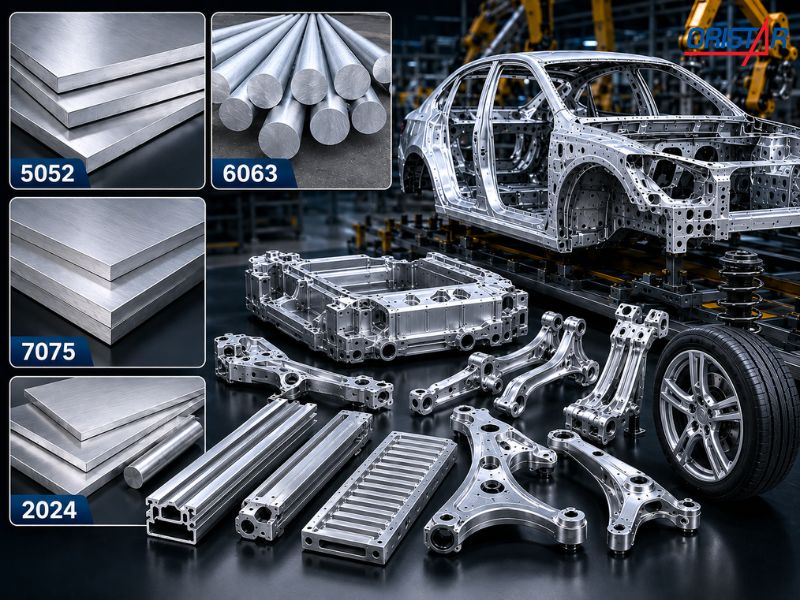
Aluminum 5052
Aluminum 5052 belongs to the aluminum-magnesium (Al-Mg) alloy group, outstanding with very good corrosion resistance and high ductility. This is one of the aluminum grades widely used for details that require complex shaping.
Outstanding features:
- Outstanding corrosion resistance in humid environments and mild chemicals
- High ductility, easy to bend and shape
- Good weldability
- Stable surface after machining
- Light weight, suitable for body parts
Advantages in the automotive industry
5052 aluminum makes it easier for manufacturers to create parts with complex shapes without sacrificing material quality. At the same time, good corrosion resistance helps prolong product life when the vehicle operates in harsh weather conditions.
Popular applications:
- Vehicle body panels
- Vehicle underbody protection shield
- Technical cover
- Interior details
- The box contains the electrical equipment
Aluminum 6061
Aluminum 6061 is one of the most used aluminum alloys in the mechanical engineering and automotive industry. This is an alloy of the Al-Mg-Si group, with a good balance between durability, machinability and corrosion resistance.
Outstanding features:
- High mechanical strength
- Good CNC machining ability
- Fairly good corrosion resistance
- Easy to weld and heat treat
- High dimensional stability
Advantages in the automotive industry:
Aluminum 6061 is often chosen for load-bearing structural members thanks to its ability to maintain durability during operation. This is also the ideal material for components that require high precision after mechanical processing.
Popular applications:
- Chassis
- Engine mount
- Electric vehicle battery frame
- Load-bearing structural assembly
- Precision mechanical components
- CNC machining details
Aluminum 6063
Aluminum 6063 also belongs to the Al-Mg-Si alloy group but has better extrusion and surface finishing capabilities than 6061. This aluminum line is widely used in shaped details and auxiliary structures.
Outstanding features:
- Excellent extrusion ability
- The surface is smooth and beautiful
- Good corrosion resistance
- Easy to anodize
- Light weight
Advantages in the automotive industry:
Aluminum 6063 is suitable for details that require high aesthetics or need mass production using extrusion technology. After anodizing, the material is resistant to oxidation and significantly increases surface durability.
Popular applications:
- Shaped aluminum bar
- Car door frame
- Auxiliary stand
- Guide rail system
- Secondary structures in the vehicle compartment
Aluminum 7075
Aluminum 7075 is an aluminum alloy containing zinc (Zn) with very high mechanical strength, often compared to some high-strength steels. This is a material used in applications that require high load and stress resistance.
Outstanding features:
- Very high tensile strength
- Good fatigue resistance
- Bear large loads
- High hardness
- Lighter weight than steel
Advantages in the automotive industry:
Aluminum 7075 is especially suitable for high-performance vehicles, sports cars or parts requiring an optimal strength-to-weight ratio. Although the cost is higher than conventional aluminum lines, the technical efficiency is very significant.
Popular applications:
- Suspension arm
- High performance transmission details
- Racing car components
- Parts that bear heavy loads
- Parts requiring special hardness and durability
Aluminum 2024
Aluminum 2024 is an aluminum-copper (Al-Cu) alloy famous for its high fatigue resistance and mechanical strength. Although widely used in the aerospace industry, this material also appears in some specialized automotive applications.
Outstanding features:
- High durability
- Good fatigue resistance
- Convenient mechanical processing
- Bear dynamic loads effectively
Popular applications:
- Load-bearing structural details
- Transmission part
- High performance components
- Mechanical assemblies require great durability
Applications of Aluminum in the Automobile Industry
Thanks to the diversity of types and technical characteristics, aluminum is present in most important systems of modern vehicles, from load-bearing structures to precision mechanical components.
Chassis System
Aluminum is used to make:
- Chassis
- Subframe
- Bearing beam
The use of aluminum significantly reduces overall weight while still ensuring structural rigidity.
Vehicle Body
Many car manufacturers today use aluminum for:
- Hood
- Car door
- Hood
- Trunk
This solution improves fuel efficiency and increases corrosion resistance.
Drive System
Some parts in the transmission system are made from aluminum to reduce weight and improve heat dissipation.
Precision Mechanical Components
Aluminum is used to process:
- Rack
- Gearbox cover
- Engine cover
- Precise assembly details
This is a group of applications that require materials with high stability and good machinability.
Heat Dissipation System
Thanks to its outstanding thermal conductivity, aluminum is widely used in:
- Két nước
- Heat exchanger
- Engine cooling system
The Role Of Aluminum In The Electric Car Industry
Sự bùng nổ của thị trường xe ô tô điện đang tạo ra nhu cầu lớn đối với các vật liệu nhẹ và có khả năng tản nhiệt tốt. Trong đó, nhôm được xem là vật liệu chiến lược giúp nâng cao hiệu suất và độ an toàn của xe điện.
Vỏ Pin
Bộ pin là thành phần nặng nhất trên xe điện.
Nhôm giúp:
- Giảm trọng lượng
- Tăng độ an toàn
- Cải thiện khả năng tản nhiệt
Khung Pin
Các bộ khung pin yêu cầu:
- Độ bền cao
- Chống ăn mòn
- Trọng lượng tối ưu
Nhôm là vật liệu đáp ứng tốt các yêu cầu này.
Vỏ Động Cơ Điện
Khả năng dẫn nhiệt và gia công tốt giúp nhôm trở thành vật liệu lý tưởng cho các cụm động cơ điện hiện đại.
Yêu Cầu Vật Liệu Trong Ngành Ô Tô – Xe Máy
Ngành ô tô – xe máy là lĩnh vực có yêu cầu rất cao về chất lượng vật liệu. Mỗi loại vật liệu được lựa chọn đều phải đáp ứng các tiêu chuẩn nghiêm ngặt về độ bền, độ ổn định và khả năng vận hành lâu dài.
Ngành ô tô – xe máy yêu cầu vật liệu phải đáp ứng đồng thời nhiều tiêu chí kỹ thuật khắt khe như:
- Độ bền cơ học cao
- Trọng lượng tối ưu
- Khả năng chịu nhiệt tốt
- Chống mài mòn
- Chống ăn mòn
- Độ ổn định trong quá trình vận hành
Đây là lý do nhôm, đồng và thép kỹ thuật được sử dụng song song trong nhiều hệ thống quan trọng của phương tiện.
Một số vật liệu phổ biến gồm:
Nhôm (Aluminum)
Ứng dụng:
- Kết cấu nhẹ
- Thân vỏ
- Khung xe
- Linh kiện cơ khí chính xác
Đồng C1020
Ứng dụng:
- Hệ thống điện
- Dây dẫn
- Đầu nối điện
- Thiết bị điện tử trên xe
Thép SS400
Ứng dụng:
- Khung chịu lực
- Kết cấu cơ khí
- Chi tiết yêu cầu độ cứng cao
Việc kết hợp các vật liệu phù hợp giúp nâng cao hiệu suất và tuổi thọ sản phẩm.
Xu Hướng Sử Dụng Nhôm Trong Ngành Ô Tô Tương Lai
Cùng với sự phát triển của công nghệ sản xuất và xu hướng chuyển đổi sang phương tiện xanh, nhu cầu sử dụng nhôm trong ngành ô tô được dự báo sẽ tiếp tục tăng mạnh trong những năm tới.
Trong những năm tới, nhu cầu sử dụng nhôm trong ngành ô tô dự kiến tiếp tục tăng trưởng nhờ:
- Sự phát triển của xe điện
- Các tiêu chuẩn khí thải nghiêm ngặt
- Xu hướng giảm trọng lượng phương tiện
- Nhu cầu nâng cao hiệu suất nhiên liệu
Đối với các doanh nghiệp sản xuất linh kiện và công nghiệp hỗ trợ, việc lựa chọn nguồn cung vật liệu ổn định và chất lượng sẽ ngày càng trở nên quan trọng.
Oristar – Đối Tác Cung Ứng Nhôm Cho Ngành Công Nghiệp Ô Tô
Để đảm bảo chất lượng sản phẩm đầu ra, các doanh nghiệp sản xuất ô tô và linh kiện cần lựa chọn nhà cung cấp vật liệu uy tín, có khả năng đáp ứng ổn định về chất lượng, số lượng và tiêu chuẩn kỹ thuật. Oristar là đơn vị cung cấp vật liệu kỹ thuật cho nhiều ngành công nghiệp công nghệ cao, trong đó có ngành ô tô – xe máy.
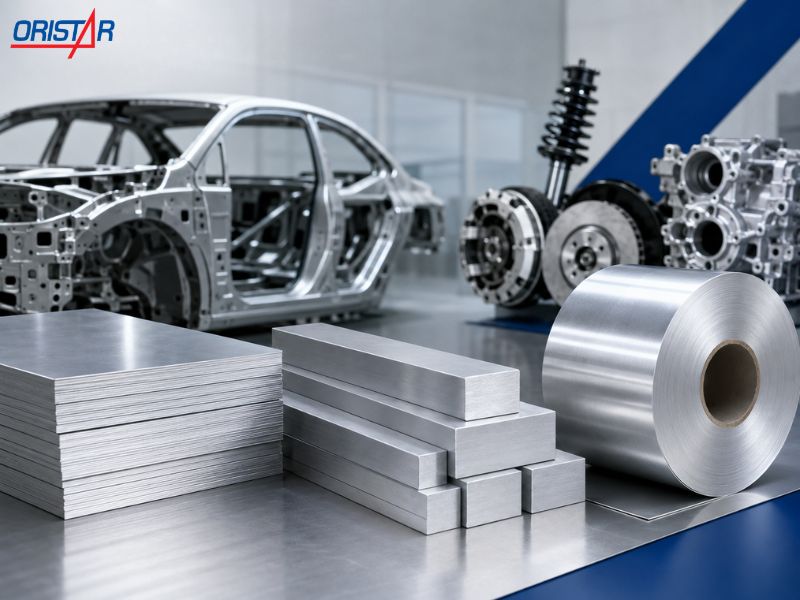
Danh mục vật liệu nhôm của Oristar đáp ứng đa dạng nhu cầu sản xuất:
- Nhôm tấm
- Nhôm thanh
- Nhôm cuộn
- Nhôm phục vụ gia công cơ khí chính xác
Bên cạnh nhôm, Oristar còn cung cấp đồng kỹ thuật và thép công nghiệp phục vụ sản xuất linh kiện, hệ thống truyền động và các chi tiết cơ khí chính xác.
Với kinh nghiệm phục vụ nhiều doanh nghiệp trong lĩnh vực cơ khí, điện tử, thiết bị kết nối và công nghiệp hỗ trợ, Oristar đồng hành cùng khách hàng trong việc lựa chọn vật liệu phù hợp, tối ưu hiệu quả sản xuất và nâng cao chất lượng sản phẩm.
Kết Luận
Nhôm đang giữ vai trò ngày càng quan trọng trong ngành công nghiệp ô tô nhờ khả năng giảm trọng lượng, tăng hiệu suất vận hành và đáp ứng các yêu cầu phát triển bền vững. Từ xe truyền thống đến xe điện, vật liệu này đều góp phần nâng cao chất lượng và hiệu quả sản xuất.
Việc lựa chọn đúng vật liệu cùng đối tác cung ứng uy tín sẽ giúp doanh nghiệp tối ưu chi phí, nâng cao năng lực cạnh tranh và đáp ứng các tiêu chuẩn ngày càng khắt khe của ngành công nghiệp ô tô toàn cầu.
Oristar - Cung cấp kim loại hàng đầu khu vực Châu Á:
- Hotline: 098 875 06 86
- Email: info@oristar.vn
- Zalo OA
- Website E-commerce
- Official Website
Khuyến cáo (Disclaimer): Mọi thông số kỹ thuật và cơ lý tính trong bài viết chỉ mang tính chất tham khảo và có thể thay đổi tùy thuộc vào quy cách, trạng thái vật liệu và nhà sản xuất. Thông số này không thay thế cho các tiêu chuẩn sản xuất chính thức (JIS, ASTM...). Quý khách vui lòng liên hệ Oristar để nhận tư vấn chi tiết và chính xác nhất cho nhu cầu của mình.